
School and K-12 Educational Building Roofing in Akron, OH for Akron commercial properties
Akron Public Schools, serving more than 20,000 students across dozens of buildings in Summit County, operates one of the largest public school facility portfolios in Northeast Ohio. The district's building inventory spans everything from century-old masonry elementary schools in the city's historic neighborhoods to modern consolidated high school campuses built in the late twentieth century, and each building type presents distinct roofing challenges in Akron's demanding climate. When a school district undertakes a major roofing program, the logistical, contractual, and scheduling complexity is orders of magnitude greater than a single-building commercial replacement—and the consequences of getting it wrong land directly on students, teachers, and taxpayers.
Summer and school break scheduling is the non-negotiable foundation of any Akron Public Schools roofing program. State law, union contracts, and basic educational continuity require that roofing work involving noise, debris, or chemical odors be completed when buildings are unoccupied by students. Ohio's roughly ten-week summer break, typically running from mid-June through late August, provides the primary window for major school roof work. A well-organized district can complete seven to ten building re-roofing projects in a single summer if the contractor mobilization is planned beginning in October of the prior year, materials are procured and staged before school lets out, and each building's scope is pre-permitted before the last bell rings in June.
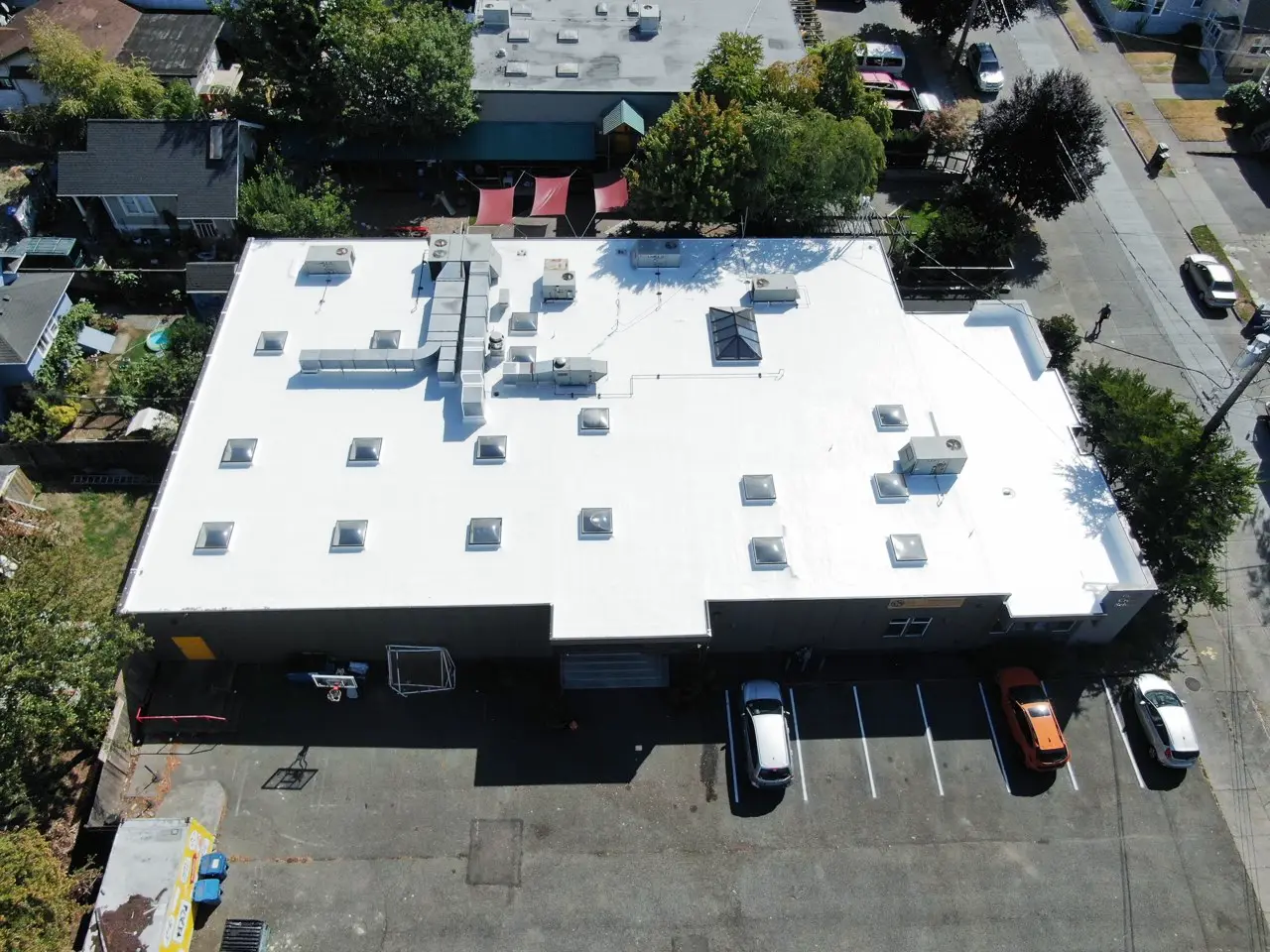
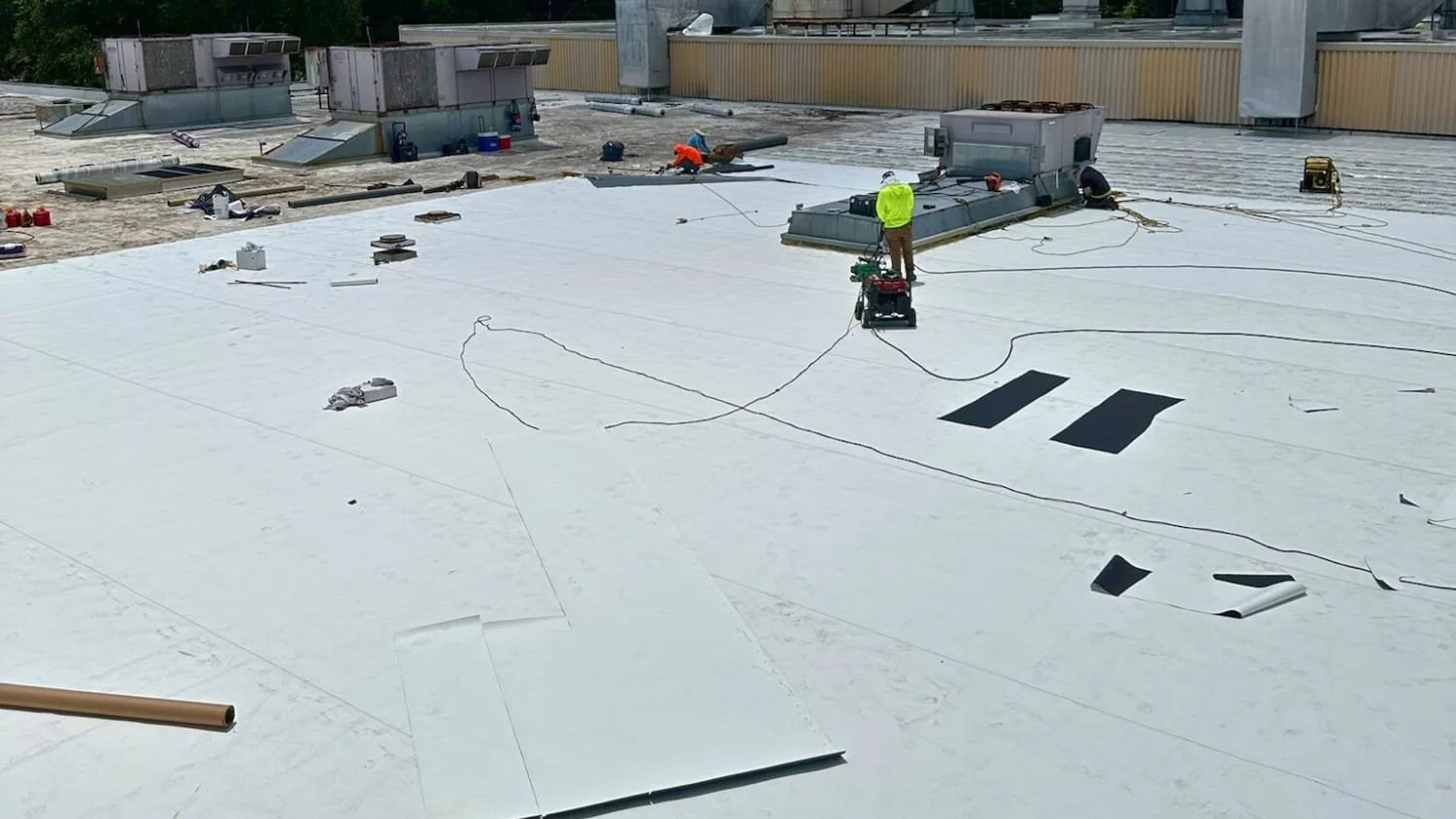
Large flat and low-slope institutional roofs are the dominant form across Akron's school building inventory. The wide-bay structural systems that allow gymnasium-scale clear spans, the multi-wing layouts of postwar elementary schools, and the loading dock areas of kitchen and maintenance facilities all present flat or near-flat roof areas that require mechanically fastened or fully adhered single-ply membrane systems. TPO has become the dominant specification for Ohio public school roofs over the past decade due to its reflectivity performance in Ohio's mixed heating and cooling climate, its weld-ability in the field that allows quality verification by trained inspectors, and its competitive pricing relative to modified bitumen systems.
Prevailing wage compliance is a mandatory and non-negotiable requirement for roofing work on Akron Public Schools facilities. Ohio's Prevailing Wage Law, enforced by the Ohio Department of Commerce, applies to public improvement contracts above the threshold for school districts, and Summit County's prevailing wage rates for roofing classifications are established and published by the state. Contractors who bid school district work must certify compliance, maintain payroll records, and submit certified payrolls to the district. Building committees and facilities directors who accept bids from non-prevailing-wage contractors—whether knowingly or because they failed to verify compliance—expose the district to significant legal and financial liability.
Multi-building district-wide roofing programs require a project delivery approach that differs from single-building commercial work. Ohio school districts have several procurement options: conventional competitive bidding, cooperative purchasing through Ohio Schools Council or other consortium agreements, and Construction Manager at Risk delivery. For large programs covering multiple buildings in a single summer, CMAR delivery often produces the best outcome because a professional construction manager can coordinate multiple roofing subcontractors across different buildings simultaneously, manage the inevitable weather delays and scope additions that emerge from pre-construction assessments, and provide the owner with a guaranteed maximum price that limits budget exposure.
Annual budget cycle timing is critical for Akron School and K-12 Educational Building Roofing in Akron, OH projects. The district's capital funds are governed by the facilities bond program, and major roofing expenditures must be included in the capital budget that is approved by the Board of Education in the spring of the prior fiscal year. Projects that are not in the approved capital budget cannot be executed regardless of how urgent the need—the exception being documented emergency conditions that threaten building safety or student welfare, which Ohio school law addresses through emergency appropriation procedures. Facilities directors who maintain multi-year condition assessment data are in the best position to build accurate capital budget requests that prioritize buildings in the most critical condition and avoid both emergency reactive spending and wasteful replacement of systems that still have useful life.
Occupied school safety protocols are required for any shoulder-season work—fall and spring projects on sections of buildings that are occupied during the school day. OSHA standards for commercial roofing apply to all school sites, and the contractor must provide fall protection for all workers at leading edges, guardrail or safety net systems at roof perimeters where workers are within six feet of the edge, and barricaded ground exclusion zones below active work areas. For Akron schools where portable classrooms or parking lots are adjacent to the building walls, the ground-level exclusion zone planning is particularly critical, and the facilities director should walk the site with the contractor's safety officer before any occupied-season work begins.
Asbestos and hazardous material management is a recurring consideration for Akron Public Schools' older building inventory. Buildings constructed before 1980 may contain asbestos-containing materials in existing roofing systems, including in built-up roofing felts, roofing mastic, and pipe insulation at roof-level mechanical penetrations. Ohio EPA regulations require that ACM be identified before demolition begins, and school districts are subject to AHERA requirements that mandate specific notification procedures before any roofing disturbance on buildings that have not been cleared of ACM through prior abatement. Any contractor proposing school district work must have a documented asbestos awareness and management plan as part of their safety program.
Long-term warranty management for a large school district roofing program requires systematic documentation that most districts underinvest in. Each building's warranty—including the manufacturer's system warranty start date, the workmanship warranty expiration, and the specific exclusions that apply—should be recorded in a facilities management database that survives personnel turnover. Warranties that are filed in a single binder in a facilities director's office and not transferred when that operating reality leaves represent a real loss of value for the district. Summit County's school facilities programs that have invested in professional facilities management software consistently report higher warranty recovery rates than those that rely on paper files.
- What procurement method is best for a multi-building Akron school district roofing program?
- Construction Manager at Risk delivery is often the most effective approach for multi-building programs because it provides owner-side coordination of multiple subcontractors, a guaranteed maximum price, and professional management of the schedule compression required to complete multiple buildings in a single summer. Ohio school districts also have access to cooperative purchasing agreements through Ohio Schools Council that can simplify procurement while maintaining compliance with public contract law.
- How does Ohio's prevailing wage law apply to School and K-12 Educational Building Roofing in Akron, OH projects?
- Ohio's Prevailing Wage Law applies to public improvement contracts above the school district threshold. Roofing contractors must pay the published prevailing wage rates for Summit County roofing classifications, maintain certified payroll records, and submit those records to the district as required. Non-compliance exposes the contractor to wage underpayment claims and the district to liability for failure to enforce the requirement.
- How do we handle asbestos in older Akron School and K-12 Educational Building Roofing in Akron, OH systems?
- AHERA and Ohio EPA regulations require identification of asbestos-containing materials in all school buildings before roofing disturbance begins. If ACM is present in the existing roofing system, it must be removed by a licensed Ohio asbestos abatement contractor before or concurrent with the roofing tear-off. Budget and schedule for potential ACM identification and abatement should be included in every pre-bid scope for buildings constructed before 1980.
- Can school roof work proceed during occupied school days?
- Limited scope work—membrane repairs, drain cleaning, non-destructive inspection—can proceed during occupied school days with appropriate safety controls. Major tear-off and re-roofing work should be confined to summer and school break periods. Any work near or adjacent to occupied areas requires an exclusion zone below the work area, written coordination with the principal, and OSHA-compliant fall protection for all workers.
- How should we time the capital budget request for a major roofing program?
- Begin the facility condition assessment and cost estimating process 12 to 18 months before the target construction year. Submit the capital budget request to the Board of Education for inclusion in the following year's approved capital budget. Emergency repairs that cannot wait for the budget cycle can be addressed through Ohio's emergency appropriation procedures, but this should be the exception rather than the standard approach for anticipated replacements.