Spray Foam SPF Roofing in Akron, OH for Akron commercial properties
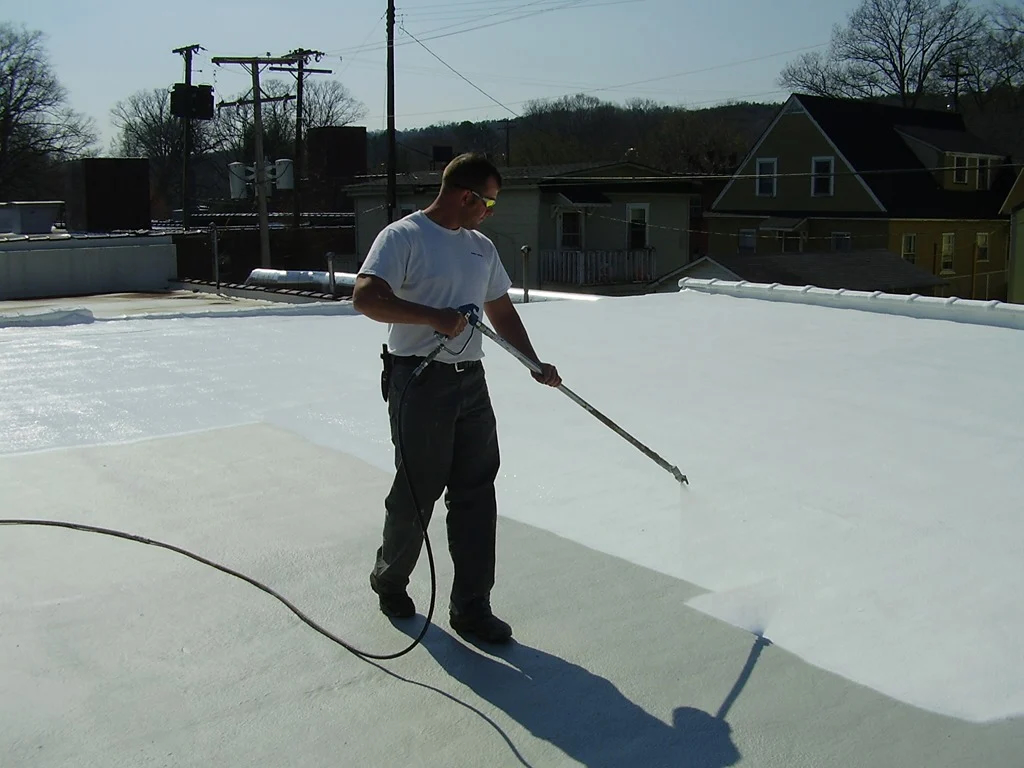
Spray polyurethane foam roofing solves a specific problem better than any other commercial roofing system: irregular, complex rooflines with numerous penetrations, unusual geometric configurations, and difficult-to-drain low areas that resist standard sheet-membrane application. Akron's polymer and rubber manufacturing legacy produced exactly this kind of building. The industrial facilities in Goodyear Heights and along the Kenmore Boulevard corridor were not built from standardized commercial construction checklists — they were made to house specific manufacturing processes, with rooflines that followed the functional requirements of production lines, overhead craneways, exhaust systems, and material handling configurations. These buildings have rooftops with enough penetrations, transitions, and irregular drainage planes that a sheet membrane installer would face a flashing scope that equals or exceeds the field membrane cost. SPF applies as a continuous spray, contouring seamlessly to any geometric configuration, forming monolithic insulation and waterproofing in a single pass without seams, laps, or discrete flashing conditions.
The application window for spray polyurethane foam in Akron's climate is genuinely constraining in a way that it is not in southern markets. SPF requires substrate temperatures above 50°F, ambient temperatures above 40°F, relative humidity below 85%, no precipitation or dew formation expected within the cure window (typically 24 hours), and wind speeds below 15 mph at rooftop level to prevent overspray and foam drift. In Akron's climate, the reliable application season runs from approximately late April through October, with May, June, and September being the most consistently suitable months. The fall application window has the advantage of getting fresh SPF and topcoat on the building before winter — maximizing the first season of performance under the warranty period. Spring installation means the building wintered without the new system; fall installation means it winters immediately with it.
Silicone topcoat durability in northeast Ohio's climate is the performance metric that justifies SPF as a premium roofing specification in Akron. SPF without topcoat degrades rapidly under UV exposure — foam that is left uncoated for even a few weeks in summer develops a surface oxidation layer that reduces adhesion and begins to deteriorate. The topcoat is the weather-facing component; the foam is the insulation and substrate. Silicone topcoat at 20–25 mils DFT provides UV resistance, ponding water resistance, and cold-temperature flexibility that other topcoat chemistries cannot match in Akron's four-season climate. The silicone-over-SPF system handles ponding water without re-emulsification, maintains flexibility at sub-freezing temperatures without cracking, and UV-stabilizes without chalking or color shift over its warranted service life. Acrylic topcoat is sometimes used over SPF in dry climates but is not appropriate for Akron's ponding-water conditions.
The Goodyear Heights and Kenmore Boulevard industrial buildings that are the natural SPF candidates in Akron require a pre-application substrate assessment that is more intensive than standard SPF projects. These buildings may have multiple roofing generations — accumulated BUR layers, mod-bit recovers, previous SPF applications that have been topcoated multiple times — and the existing surface must be evaluated for adhesion compatibility with new foam, moisture content, and structural integrity. A damp substrate beneath new SPF causes off-gassing that creates voids and delamination in the new foam layer. A structurally compromised substrate doesn't provide the bearing surface that SPF needs for long-term adhesion. Core sampling and adhesion testing are standard pre-application steps for any building with a complex or uncertain substrate history.
SPF's insulating performance is among its most compelling attributes for Akron's heating-dominated climate. Closed-cell SPF achieves R-6.5 to R-7.0 per inch, making it the highest R-value-per-inch insulation material in commercial roofing. At 2 inches of thickness — a standard SPF application for reroofing — the system provides approximately R-13 in new insulation value above whatever was present in the existing assembly. For older Akron industrial buildings with minimal original insulation (common in buildings designed and built before energy codes governed commercial construction), the combined effect of a new SPF system and silicone topcoat can meaningfully reduce both heating and cooling energy costs — a benefit that partially offsets the system's higher installed cost relative to standard single-ply alternatives.
The irregular penetrations characteristic of Akron's older industrial buildings — gas lines, process pipes, electrical conduit arrays, and research equipment installations — receive SPF treatment that is superior to any sheet-membrane flashing detail. SPF is simply sprayed around and over each penetration, conforming to its geometry, bonding to its surface, and creating a continuous foam body that transitions from the field area to the penetration without a separate flashing component. The silicone topcoat covers the entire foam surface including all penetration areas, completing the weatherproofing without a separate counter-flashing or termination bar at each pipe. For a building with 80 individual penetrations, this approach eliminates 80 discrete flashing conditions — 80 potential freeze-thaw failure points — replacing them with a single continuous waterproofing surface.
University of Akron research buildings and the Bounce Innovation Hub have rooftop equipment configurations that evolve over time as research programs change and business tenants expand. SPF's ability to accommodate new penetrations cleanly — cut a hole, apply foam around the new penetration, topcoat the repair area — makes it particularly well-suited to rooftop environments where the penetration inventory changes periodically. On a sheet-membrane roof, adding a penetration requires a detailed flashing condition that must be integrated with the existing membrane system; on an SPF roof, new penetrations are accommodated by spot application that matches the existing foam profile and topcoat chemistry.
Life cycle maintenance for SPF in Akron involves recoating at the end of the topcoat's warranted service life — typically 10–15 years for silicone at standard thickness — without removing or disturbing the foam substrate. This recoat approach is one of SPF's long-term economic advantages: the foam substrate, if maintained properly without physical damage, can remain in service indefinitely with successive topcoat cycles. Each recoat is a fraction of the original installation cost, allowing a building owner to essentially extend the roof's service life on a rolling 10–15 year cycle without the capital impact of full replacement. For building owners with a long-term hold horizon on older Akron industrial properties, this lifecycle model is compelling.
Questions Owners Ask
Is SPF a good choice for a standard commercial flat roof in Fairlawn, or is it only for complex buildings?
SPF is technically viable on any commercial flat roof, but its cost advantage is most compelling on buildings where the penetration density and roofline complexity make sheet-membrane flashing scope expensive. For a standard rectangular flat-roof building in Fairlawn with four HVAC curbs, a standard drain, and minimal penetrations, TPO or EPDM with heat-welded seams typically provides better value — lower installed cost, comparable performance, and widespread installer qualification for future service. SPF's premium is justified when penetration density or geometric complexity is high enough that the elimination of individual flashing conditions provides real value, typically 15+ penetrations per 10,000 square feet or significant roofline complexity.
What happens if SPF is damaged — say, by a dropped tool or HVAC work?
SPF is repairable by spot application of new foam over the damaged area, followed by topcoat at the repair site. Small mechanical damage — tool drops, foot traffic compression — is typically addressed by scraping loose foam, applying new foam to restore the original profile, and topcoating the repair area to match the existing surface. The repair is completely monolithic with the original application when executed correctly. Larger damage events — a fallen antenna mast or significant mechanical impact — may require removing a larger foam section and refoaming to match existing contour. SPF repair is faster and less costly per square foot than sheet-membrane repair at equivalent damage extent.
How is SPF installed on a building that is still occupied and operating?
SPF application requires the building's air intakes to be shut down or protected during active spraying, since isocyanate vapor in the spray process is a respiratory hazard. Application is scheduled when the HVAC system can be in unoccupied-mode or when specific air handling units serving occupied areas can be temporarily shut. On campus and medical facilities, this coordination requires advance planning with the facilities management team. After the foam and topcoat have fully cured — typically 24 hours — the building's ventilation can be restored with no ongoing occupant exposure concern from the cured materials.
Does SPF require any special permits or contractor certifications in Akron?
SPF application requires contractor certification through the Spray Polyurethane Foam Alliance (SPFA) training program; properly certified installers have documented training in application equipment calibration, substrate preparation, environmental condition monitoring, and safety protocols for isocyanate handling. Summit County building permits are required for new SPF roofing installations under the same threshold rules that apply to other commercial roofing work. We maintain current SPFA certifications for our SPF crews and pull all required permits for SPF projects in the Akron metro area.
Can SPF be applied over an existing single-ply membrane without tear-off?
Yes — SPF can be applied over qualifying existing single-ply membranes (TPO, EPDM, PVC) in sound condition, subject to moisture scan confirmation of dry insulation and adhesion testing of the SPF to the existing membrane surface. The existing membrane becomes the vapor retarder in the new SPF assembly. This approach avoids the tear-off cost while providing new insulation, new waterproofing, and new topcoat in a single application. The critical requirement is dry insulation confirmed by infrared scan and cores — SPF over wet insulation creates the same long-term problems as any other membrane system over wet insulation.