Standing Seam Metal Roofing in Akron, OH for Akron commercial properties
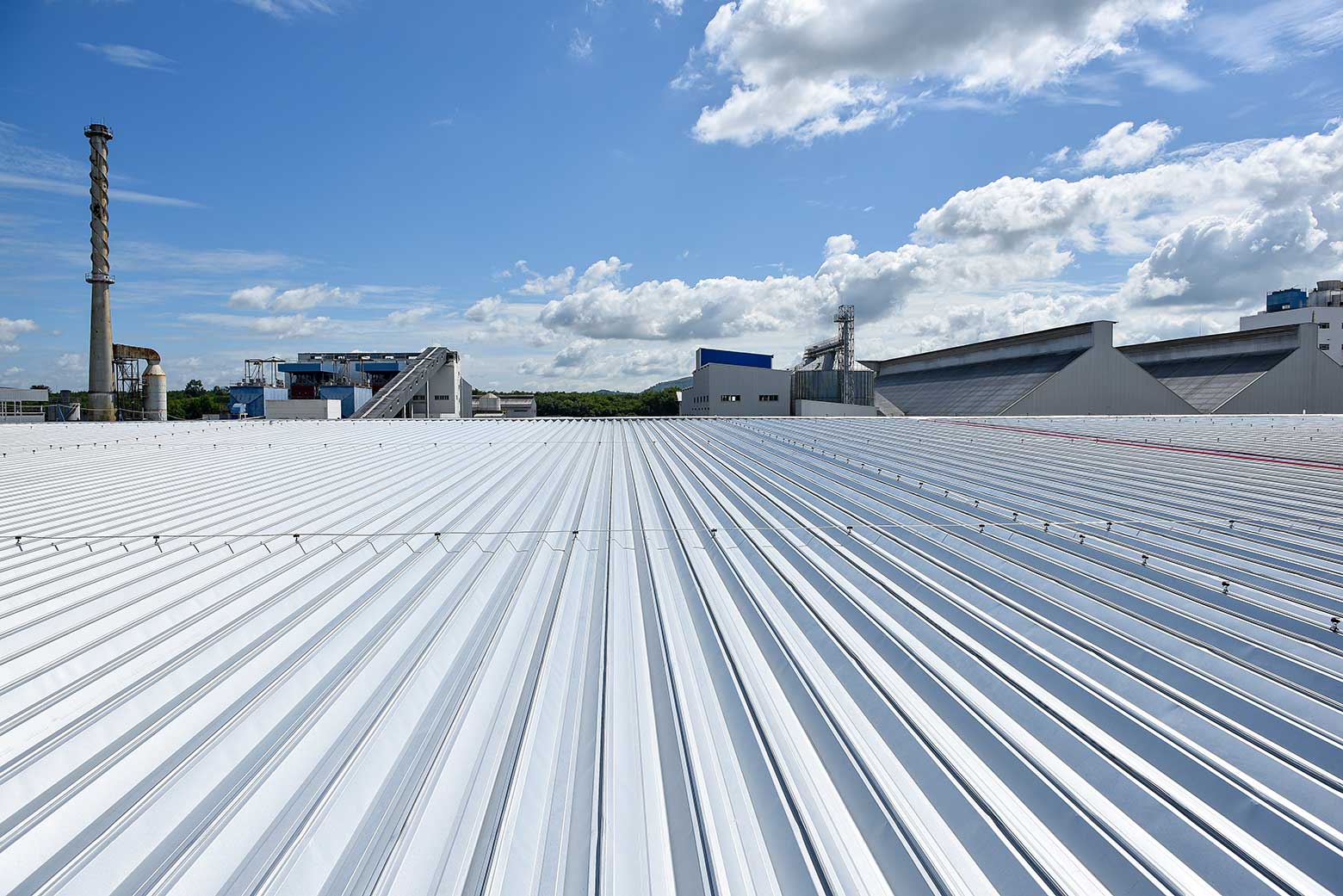
Standing-seam metal roofing earns its premium specification position in the Akron commercial market through a performance attribute that matters especially in northeast Ohio's climate: concealed fasteners. Unlike R-panel and other exposed-fastener metal systems, standing seam is attached through a clip system that is completely hidden beneath the interlocking seam — no fastener penetrates the panel face, and there is no neoprene washer seal anywhere in the system that can degrade from freeze-thaw cycling. The result is a roofing system that handles Akron's 47.2 inches of annual snowfall, its January-February snow concentration, and its hundreds of annual freeze-thaw cycles without the fastener-backout and washer-seal degradation that eventually compromises every exposed-fastener metal system in this climate.
The Fairlawn-Bath commercial corridor is the highest-concentration standing-seam installation zone in the Akron metro area, and the reasons are largely aesthetic and tenant-driven. Premium retail, medical office, and professional service buildings along Cleve-Mass Road, Bath Road, and the Montrose area attract tenants who expect architectural quality in their building envelope, and standing-seam's clean sight-line profile — no fastener dots, no lap patterns, just continuous vertical ribs — is a premium finish that distinguishes a building from commodity metal construction. Architectural standing seam in Kynar-coated steel or aluminum at 12-inch or 16-inch panel widths is the specification that property developers in this corridor use to position their buildings at the market's upper tier, and it delivers on that promise durably — a well-installed standing-seam system on a Fairlawn commercial building will outlast most of the tenants who lease below it.
Montrose-Ghent's dense commercial and mixed-use district — the most active retail and dining concentration in the Akron metro outside of downtown — has seen significant standing-seam installation on both new construction and building renovation projects over the past 15 years. The combination of high visibility (proximity to I-) and premium use (restaurant pads, specialty retail, medical office conversion) justifies the standing-seam specification premium in this location. We have installed and maintained standing-seam systems on multiple Montrose-Ghent commercial properties and are familiar with the architectural profiles and color specifications that building owners and property managers in this district prefer.
Hudson and Stow corporate buildings represent the outer-ring Summit County standing-seam market — corporate headquarters, office parks, and professional service facilities where architectural quality and long-term low-maintenance performance are both priorities. Corporate campus buildings in the Hudson-Stow corridor are often owner-occupied by companies that measure building lifecycle costs in decades, and standing-seam's 40-year-plus service life potential with minimal maintenance aligns well with that investment horizon. The Galvalume steel substrate combined with Kynar 500 fluoropolymer coating provides a finish system that maintains its color and corrosion resistance through the full temperature cycling range that Akron's four-season climate produces, without the fading, chalking, or surface oxidation that affects lower-quality coated steel in this climate.
Thermal movement is the design challenge that standing-seam solves more elegantly than any other metal system. Steel expands approximately 0.0000065 inches per inch of length per degree Fahrenheit of temperature change. A 40-foot standing-seam panel on an Akron commercial building experiences seasonal surface temperatures ranging from perhaps -10°F in a cold January night to 160°F on a summer afternoon absorbing solar radiation — a 170-degree range that produces 0.53 inches of linear movement over the panel's length. Standing-seam's floating clip attachment allows this movement to occur freely without buckle or fastener stress, while the interlocking seam maintains continuous weatherproofing throughout the full movement range. Exposing standing-seam panels are designed and fabricated with the thermal expansion coefficient of the specific metal in mind; we specify appropriate clip types and panel lengths to accommodate the actual thermal range at each installation location.
Snow shedding from standing-seam roofs is a specific design consideration for Akron's commercial buildings in locations where shed snow or ice would create hazards. The smooth, sloped surface of a standing-seam system can allow large snow and ice masses to shed suddenly when solar warming breaks the surface bond — a condition that creates serious hazards at building entries, pedestrian walkways, parking areas adjacent to the building, and mechanical equipment locations. Snow retention systems — eave brackets, pipe-style snow fences, or pad-style snow guards — are installed on Akron standing-seam roofs wherever shed snow would create a hazard. We design snow retention as an integral part of any standing-seam installation rather than a retrofit afterthought, sizing the retention capacity for the specific roof slope, panel width, and projected accumulation loads.
Akron-Canton Airport's commercial corridor presents a specific corrosion consideration for standing-seam installations. Airport-adjacent buildings experience de-icing chemical exposure — both from aircraft ground operations and from highway de-icing of the access roads — that creates a more aggressive corrosion environment than the general Akron metro. Standing-seam specifications for CAK-adjacent buildings should include premium Galvalume or aluminum panel material with appropriate Kynar coating, and we advise annual cleaning of panel surfaces in the airport zone to remove de-icing chemical accumulation that could accelerate coating degradation if left in contact with the metal surface.
Installation quality is the defining variable in standing-seam performance over a 40-year service life, and the quality differences between skilled and unskilled standing-seam installation are not visible at completion — they reveal themselves over the first decade of service. Critical quality elements include: panel seam engagement at the full designed interlock depth (under-engaged seams are a primary leak failure mode), clip spacing appropriate for wind uplift loads (the Akron area's wind exposure category requires specific uplift resistance), sealant application at end laps and transitions, and thermal movement accommodation at fixed and floating clip locations. We maintain a standing-seam installation quality program with panel probe testing and seam engagement documentation on all commercial projects.
Questions Owners Ask
What does standing-seam metal roofing cost compared to TPO or EPDM for an Akron commercial building?
Standing-seam metal installed cost in the Akron commercial market ranges from $18–$30 per square foot for standard Galvalume steel systems, to $28–$45 for premium aluminum or copper applications on architectural projects. This compares to $10–$14 per square foot for standard single-ply TPO or EPDM. The premium is substantial, but the lifecycle comparison changes the picture: a 40-year standing-seam system versus two 20-year TPO cycles reduces the total lifetime cost differential significantly, particularly when the cost of re-roofing disruption to a premium tenant or owner-occupied building is included in the calculation.
How long does standing-seam metal roofing last in northeast Ohio?
Properly installed Galvalume standing-seam with Kynar 500 finish coating carries 40-year paint warranties from major coil coating manufacturers and real-world panel service life that routinely reaches 50-60 years with minimal maintenance in northeast Ohio's climate. The concealed-fastener design eliminates the primary failure mode of exposed-fastener systems in this climate. The most common mid-life maintenance item is sealant replacement at end laps and penetration details, which is required at 15-20 year intervals as sealant ages. Field membrane failures requiring panel replacement are uncommon in properly installed systems before the 40-year mark.
Can standing-seam metal be installed on a low-slope roof, or does it require steep pitch?
Structural standing-seam systems are rated for minimum slopes as low as 1/4:12 in some profiles, though most manufacturers specify 1/2:12 or steeper for their standard water-shedding profiles. On very low-slope applications, seam sealant and specific panel profiles with elevated seam heights are required to prevent water intrusion from wind-driven rain or ponding. Architectural standing seam at 3:12 or steeper is the most common commercial specification and provides the cleanest performance across Akron's full precipitation and wind profile. We evaluate the specific roof slope and exposure conditions before selecting the appropriate panel profile and attachment system for each project.
Does standing-seam metal need to be painted, or is bare Galvalume acceptable?
Bare Galvalume (aluminum-zinc alloy coated steel) without paint finish is acceptable for industrial and utilitarian applications where appearance is not a consideration — agricultural buildings, industrial sheds, secondary structures. For commercial buildings on the Fairlawn-Bath corridor, Montrose-Ghent, or in any location where appearance matters, Kynar 500 or similar fluoropolymer coating is the standard specification. Kynar finish provides UV stability, color retention, and chalk resistance that bare Galvalume does not offer. The color selection for commercial standing seam in the Akron market ranges from standard industry colors to custom matching for branded building programs.
What is the difference between structural and architectural standing seam?
Structural standing seam panels are formed with specific rib geometries that allow them to span between supports without additional decking — the panels themselves are the structural members. These are used on sloped metal building systems where the panels span between purlins. Architectural standing seam panels are applied over a continuous substrate (existing deck or new substrate board) and function as a weathering surface rather than a structural element. Most commercial reroofing and low-slope standing-seam applications in the Akron market use architectural panels over a continuous substrate, which provides better thermal performance and is appropriate for the slope range of most commercial buildings.