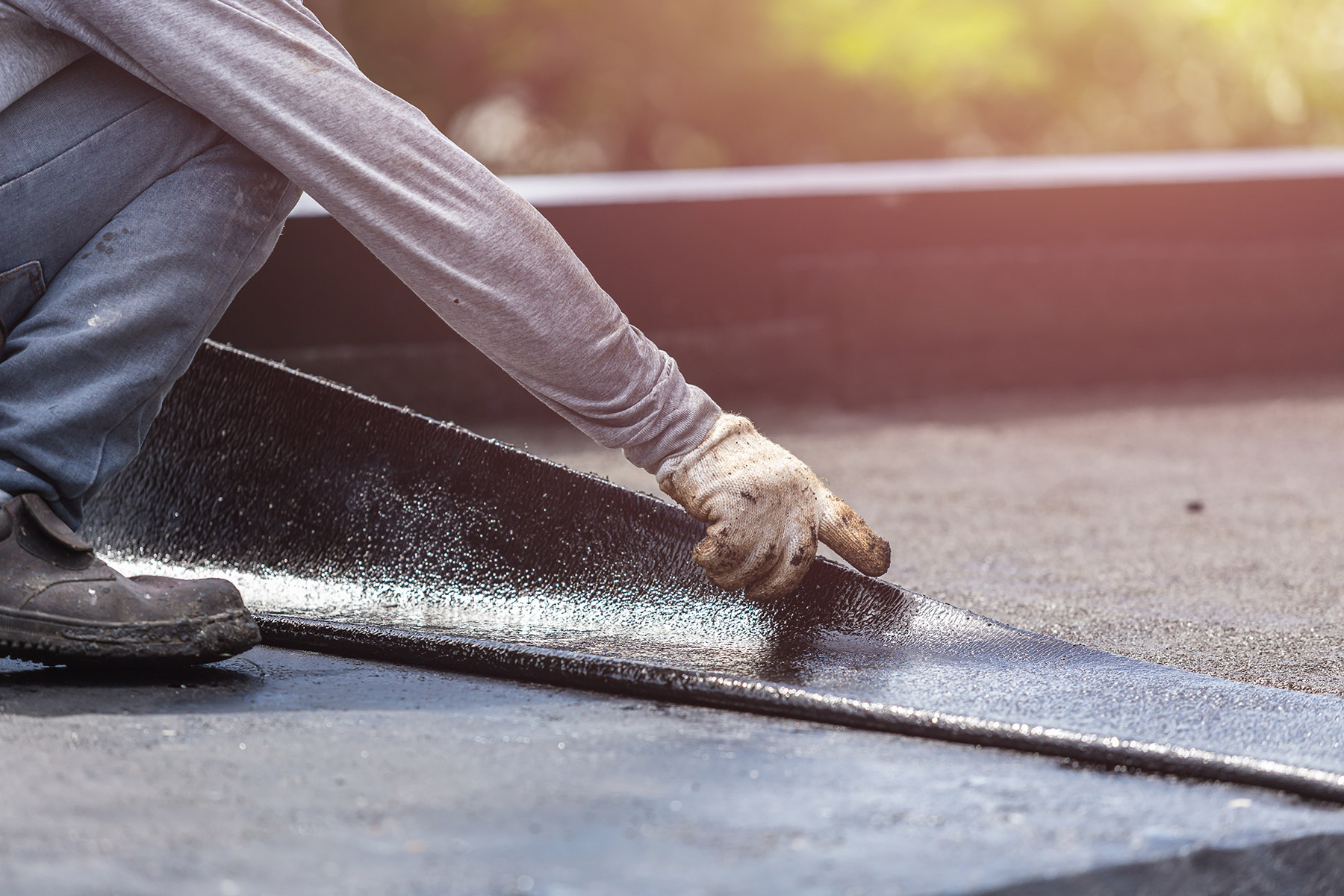
PVC Roofing in Akron, OH for Akron commercial properties
PVC Roofing in Akron, OH's defining attribute — chemical resistance — finds a natural application environment in Akron, where the polymer and rubber manufacturing legacy has left behind a commercial building stock with chemical exposure profiles that standard TPO or EPDM cannot address. Restaurants and commercial kitchens in the Northside District, Highland Square, and throughout the Merriman Valley add a different dimension: rooftop kitchen exhaust creates grease aerosol deposits and cooking oil vapor plumes that attack non-resistant membranes with the same destructive chemistry as industrial solvents. PVC's chlorinated polymer backbone resists these chemical attacks in a way that gives it a specific performance advantage in Akron's mixed commercial environment — manufacturing facilities and restaurants alike.
The restaurant and retail buildings of Northside District and Highland Square represent a concentrated PVC application zone. These neighborhoods host a significant density of independent restaurants, bars, and food service operations in converted commercial and historic retail buildings, and their rooftop environments are dominated by kitchen exhaust from hoods that discharge cooking grease aerosols year-round. Grease accumulation on a rooftop membrane that has been in contact with an EPDM or TPO surface for five or ten years shows as softening, discoloration, and eventually plasticizer extraction (in TPO) or surface attack (in EPDM) in the area of the exhaust plume. PVC maintains its membrane integrity in grease environments and cleans readily with appropriate solvents, allowing the roof surface to be cleaned and maintained without membrane damage.
Plasticizer migration is PVC's most discussed long-term performance concern, and it deserves honest treatment rather than dismissal. Standard PVC Roofing in Akron, OH membranes contain phthalate or alternative plasticizers at 20–30% by weight that keep the membrane flexible throughout its service life. These plasticizers migrate slowly over time and can migrate more rapidly in cold temperature extremes, in contact with incompatible materials, or in chemical exposure environments. In Akron's temperature extremes — both the summer heat and the winter cold create migration-favorable conditions — plasticizer loss in standard PVC can cause the membrane to stiffen and crack at seams and flashings over a 15–20 year service life. The mitigation is specification of high-quality PVC with non-phthalate plasticizers (regulatory pressure has moved the industry toward alternatives) and, more importantly, regular seam inspection to identify and repair marginal seams before they become open failures.
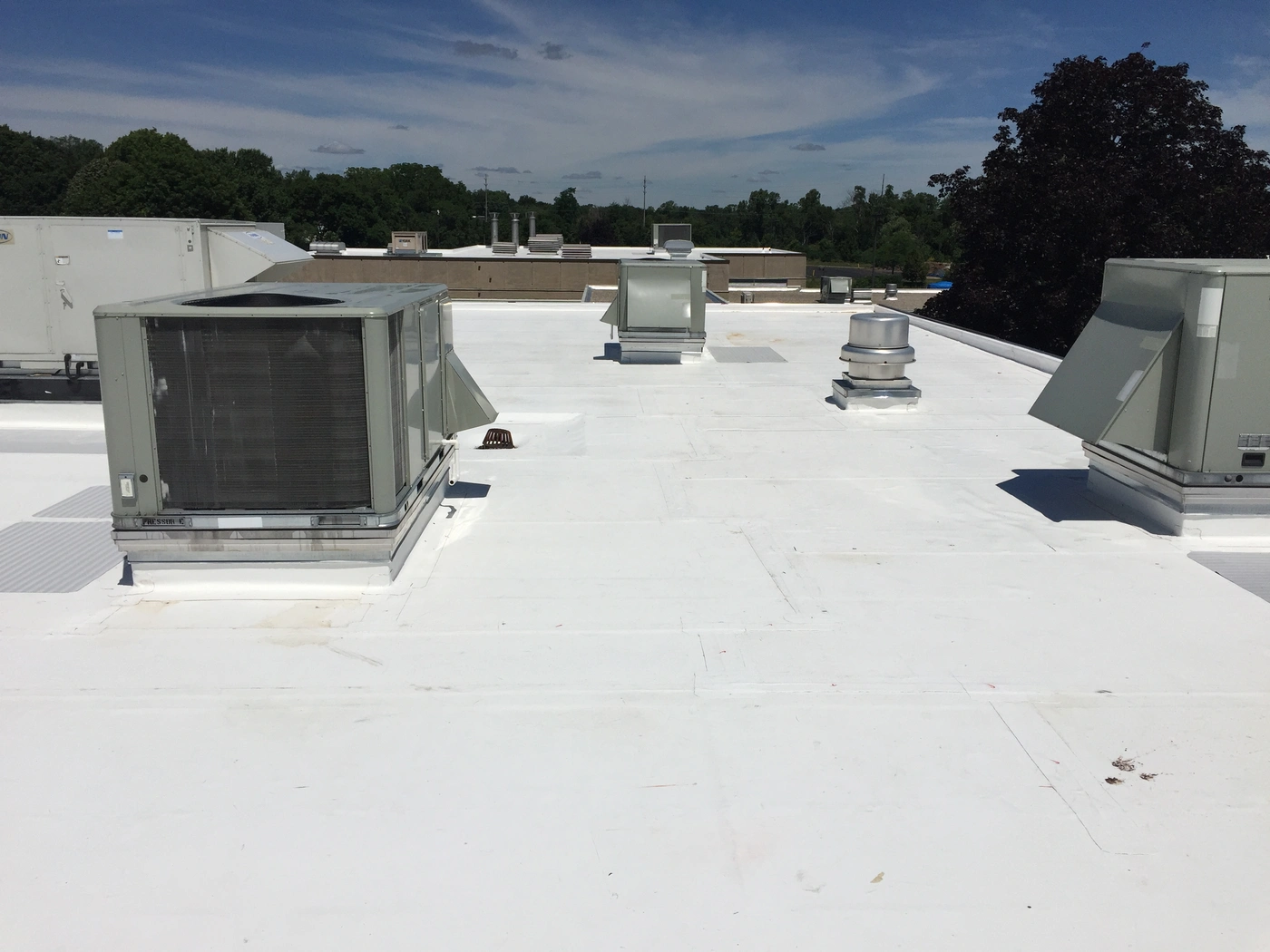
PVC heat-welded seams are the specification's primary performance advantage over adhesive-seam systems like EPDM. Hot air welding fuses two PVC layers into a single continuous thermoplastic mass at the seam — the weld is as strong as the base membrane and does not rely on adhesive chemistry that can degrade in Akron's freeze-thaw cycling. This seam integrity advantage is why PVC (and TPO, which has the same weld chemistry) have become the dominant specifications for new commercial roofing in northeast Ohio over the past two decades, replacing adhesive-seam EPDM in most new and recover applications. The weld quality depends entirely on operator technique and equipment calibration — properly trained and equipped installers produce welds that routinely pass 250-psi probe testing; inadequately trained installers produce welds that fail in the first season.
Akron's polymer manufacturing facilities — the remaining active chemical processing and compounding operations in the Goodyear Heights industrial corridor and the chemical specialty manufacturing along East Market Street — require a chemical compatibility review before PVC specification. PVC resists many chemicals that attack EPDM, but it is not universally resistant: concentrated aromatic solvents (benzene, toluene, xylene), chlorinated solvents, and some polymer processing chemicals can attack PVC plasticizers or the polymer backbone itself. For buildings where specific chemical exposure is a known factor, we consult the membrane manufacturer's chemical resistance chart and, where compatibility is uncertain, recommend KEE (ketone ethylene ester) single-ply as a more robust alternative. PVC should not be specified for chemical-exposure applications without chemical compatibility confirmation for the specific exposure.
Membrane thickness is a specification variable that matters in Akron's commercial environment. Standard PVC comes in 50-mil (0.050-inch) and 60-mil thicknesses; premium specifications go to 80-mil. For commercial rooftops with regular maintenance traffic — HVAC service, restaurant exhaust cleaning, research lab equipment access — 60-mil PVC provides meaningful additional puncture and mechanical damage resistance at a modest cost premium over 50-mil. We specify 60-mil as the standard for Akron commercial installations and reserve 50-mil for lightly accessed simple rooftops where the cost difference justifies the slightly reduced durability margin.
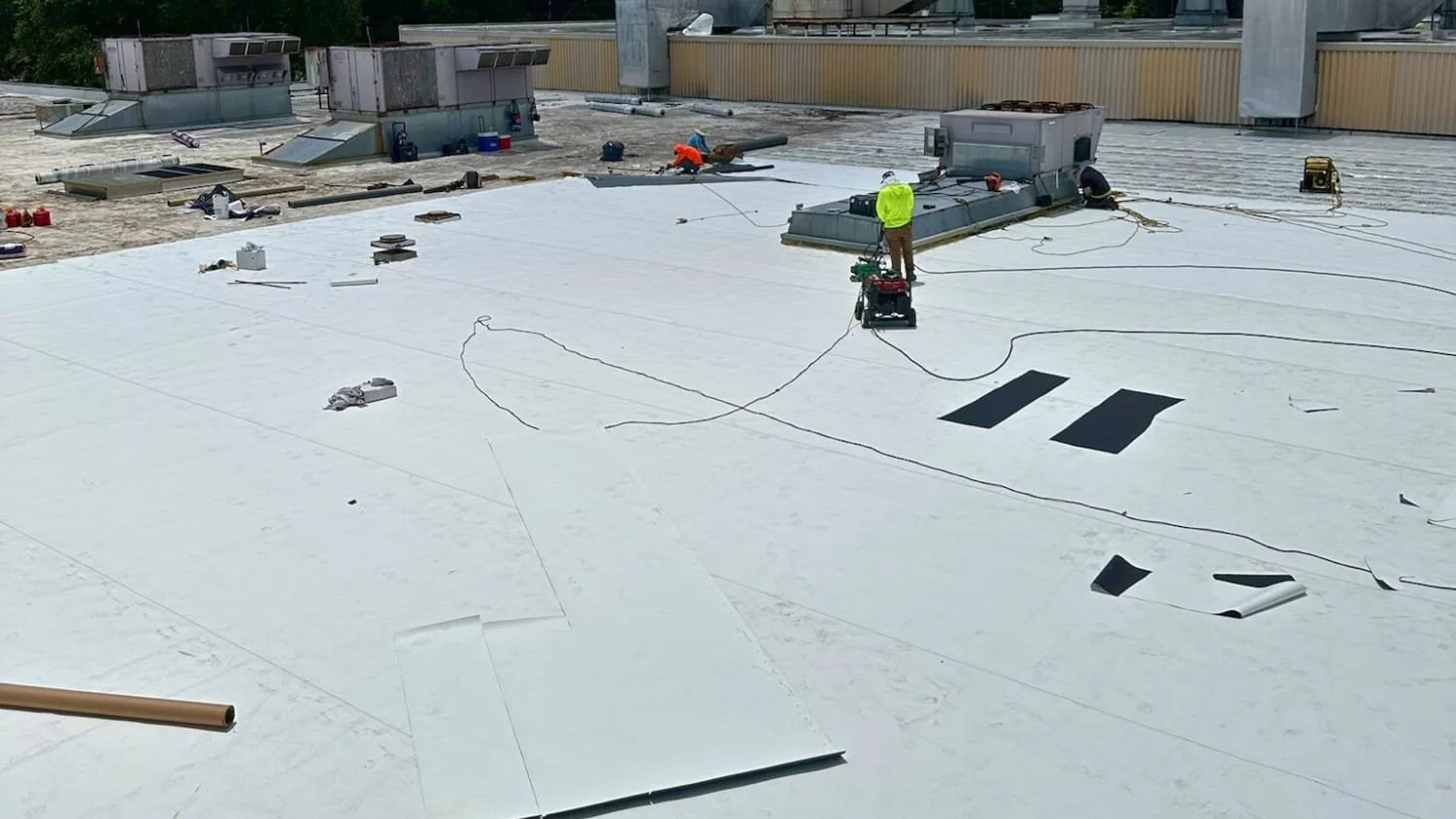
PVC installation in Akron's climate requires the same temperature discipline as other single-ply systems: substrate temperatures above 40°F for adhesive bonding (fully adhered systems), and welding equipment calibrated for the ambient temperature, since hot-air welder settings must be adjusted for cold conditions to maintain proper melt temperature at the weld zone. Our crews carry digital thermometers and welding equipment calibrated through laboratory testing, not just field experience, to ensure consistent weld quality across the variable ambient conditions that Akron's spring and fall installation windows can produce. All welds on commercial PVC projects receive probe testing per NRCA guidelines before inspection closeout.
The Merriman Valley commercial corridor along Merriman Road between Akron and Cuyahoga Falls combines retail, restaurant, and service commercial uses in a landscaped suburban environment with mature tree canopy — a combination that creates high organic debris loads on commercial rooftops and regular gutter clearing requirements. PVC rooftops in this environment benefit from annual gutter and drain cleaning as a maintenance practice, since organic debris accumulation in direct contact with the PVC surface over extended periods can stain and marginally affect surface chemistry in the plume where debris decomposes. This is not a structural performance concern but affects the long-term appearance and maintenance ease of the roof surface.
Questions Owners Ask
Is PVC or TPO better for an Akron commercial building?
For most Akron commercial buildings without specific chemical exposure, TPO and PVC offer comparable performance — both heat-weld, both provide similar reflectivity options, and both handle northeast Ohio's freeze-thaw climate adequately with proper specification. TPO carries a modest cost advantage and has become the dominant commercial specification in this market. PVC's specific advantage is its broader chemical resistance, making it the preferred specification for restaurants, food service buildings, and facilities with rooftop chemical exposure. If your building has kitchen exhaust, chemical processes, or documented chemical exposure at rooftop level, PVC is the appropriate specification. For a standard office, warehouse, or retail building, TPO typically provides better value.
How does PVC hold up in Akron's winter temperatures?
PVC at standard specification maintains flexibility at down to -20°F, which is well below Akron's historical minimum temperatures. Cold-temperature flexibility is not a significant performance concern for properly specified PVC in this market. The relevant cold-weather concern for PVC is plasticizer migration rate — cold temperatures slow plasticizer migration, but repeated cycling through cold-to-warm-and-back accelerates it slightly relative to a stable-temperature environment. Modern PVC formulations with non-phthalate plasticizers have improved cold-temperature plasticizer stability significantly over products from the 1990s.
My restaurant has an PVC roof that looks yellowed and stained near the hood exhausts. Is it damaged?
Yellowing and staining near kitchen exhaust outlets is primarily cosmetic and results from grease aerosol and cooking oil deposit accumulation on the membrane surface. It does not necessarily indicate membrane damage, but the area should be cleaned and inspected for surface softening or plasticizer extraction at the stain boundary. Grease deposits that are left in long-term contact with PVC can cause localized plasticizer extraction and eventual stiffening of the membrane in the high-exposure zone. We recommend annual cleaning of exhaust plume areas on restaurant-occupied PVC rooftops to prevent progressive accumulation.
Can PVC be repaired if it develops a crack or seam failure?
Yes — PVC is among the most field-repairable single-ply systems. Cracks and seam failures are repaired with PVC cover strips heat-welded to the existing membrane surface after thorough cleaning and surface preparation. The weld mechanics are the same as original installation — the repair patch is fully fused, not adhesive-bonded, and produces a permanent closure when executed correctly. Unlike EPDM repairs that require specific primers and seam tape, PVC repairs require only a heat source and compatible membrane material, making them faster and more reliable in field conditions.
Does PVC require a specific primer or adhesive for installation?
Fully adhered PVC systems use bonding adhesive applied to both the membrane underside and the insulation surface, similar to EPDM installation. The adhesive used for PVC is specific to PVC chemistry — using EPDM adhesive on PVC or vice versa is a common installation error that produces inadequate adhesion. Mechanically attached PVC systems use fabric-backed membrane through which fastener plates are installed; these do not require adhesive for the field membrane. All PVC manufacturer warranties require manufacturer-approved adhesives and accessories for warranty coverage.