

Solar Roof Integration in Akron, OH for Akron commercial properties
A rooftop solar array is supposed to last twenty-five years or more. The roof underneath it usually will not, unless someone plans for that gap up front. We get called onto Akron buildings every year where a perfectly good PV system sits on a membrane with four or five years left in it, and the owner is staring down a bill to detach, store, and reset the entire array just to replace the roof. Solar Roof Integration in Akron, OH is the work of preventing exactly that situation, and it starts with the roof, not the panels.
Why the roof has to lead the project
Akron's commercial solar interest tracks with the buildings that have the most roof to work with: the warehouse and light-industrial stock along the I-77 and Route 8 corridors, the converted polymer-era plants around Firestone Park and Kelly Avenue, and the larger flat roofs on retail and institutional buildings near Montrose and Chapel Hill. Those are big, mostly low-slope decks, and they are attractive to solar developers for the same reason they are demanding for roofers. When a developer prices an array for one of these roofs, the proposal almost never accounts for the condition of the membrane it is bolting to. That part is ours to evaluate.
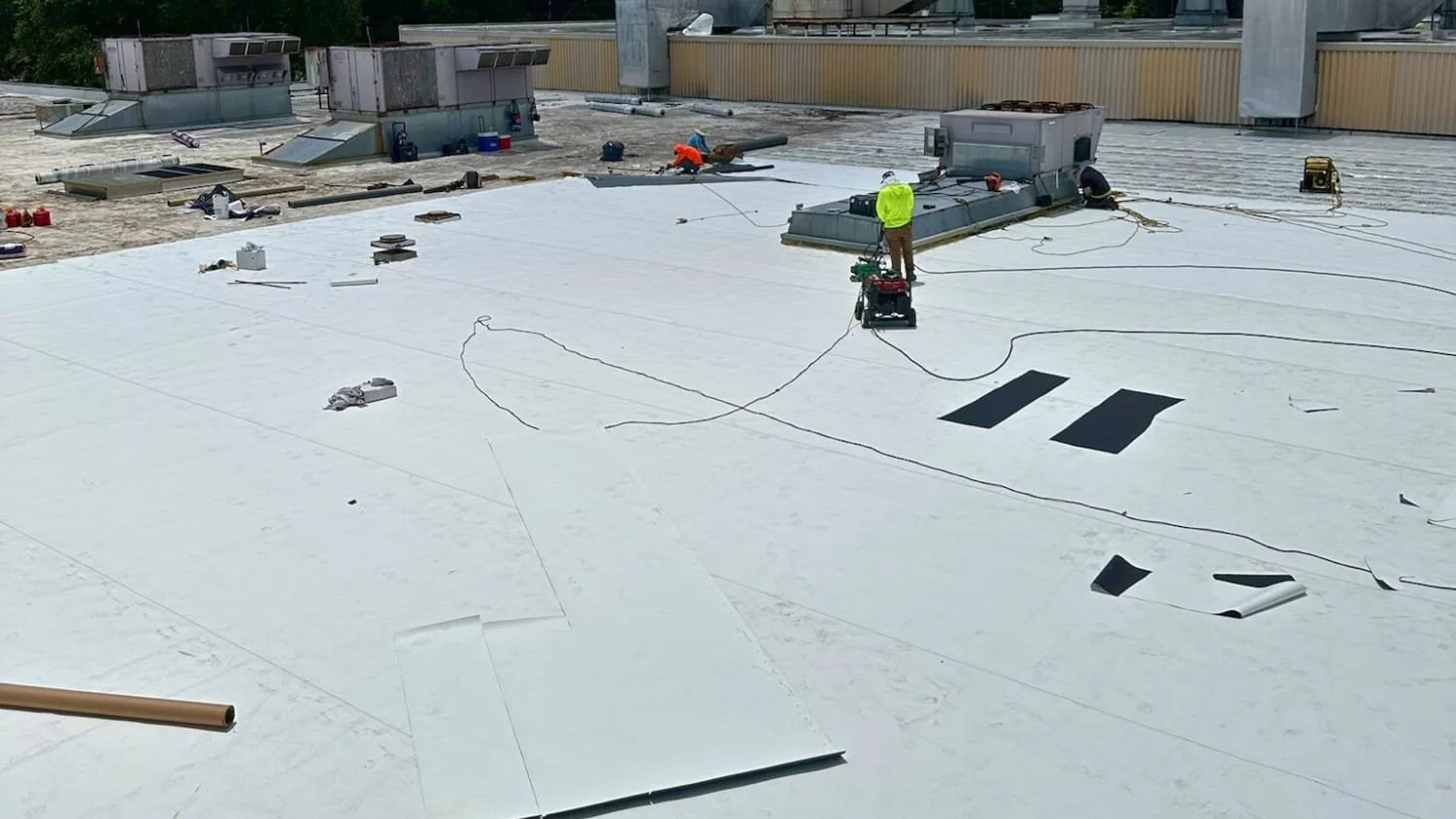
We look at remaining service life before anything else. If the existing membrane has fifteen or more years of documented life left, the array can go on what is there. If it has seven years or fewer, reroofing first is almost always the cheaper path over the life of the system, because tearing an array off and putting it back during a future replacement can add tens of thousands of dollars to that reroof. The in-between cases are where judgment matters, and we would rather have that conversation with you before the solar contract is signed than after.
Penetrations, racking, and keeping the membrane intact
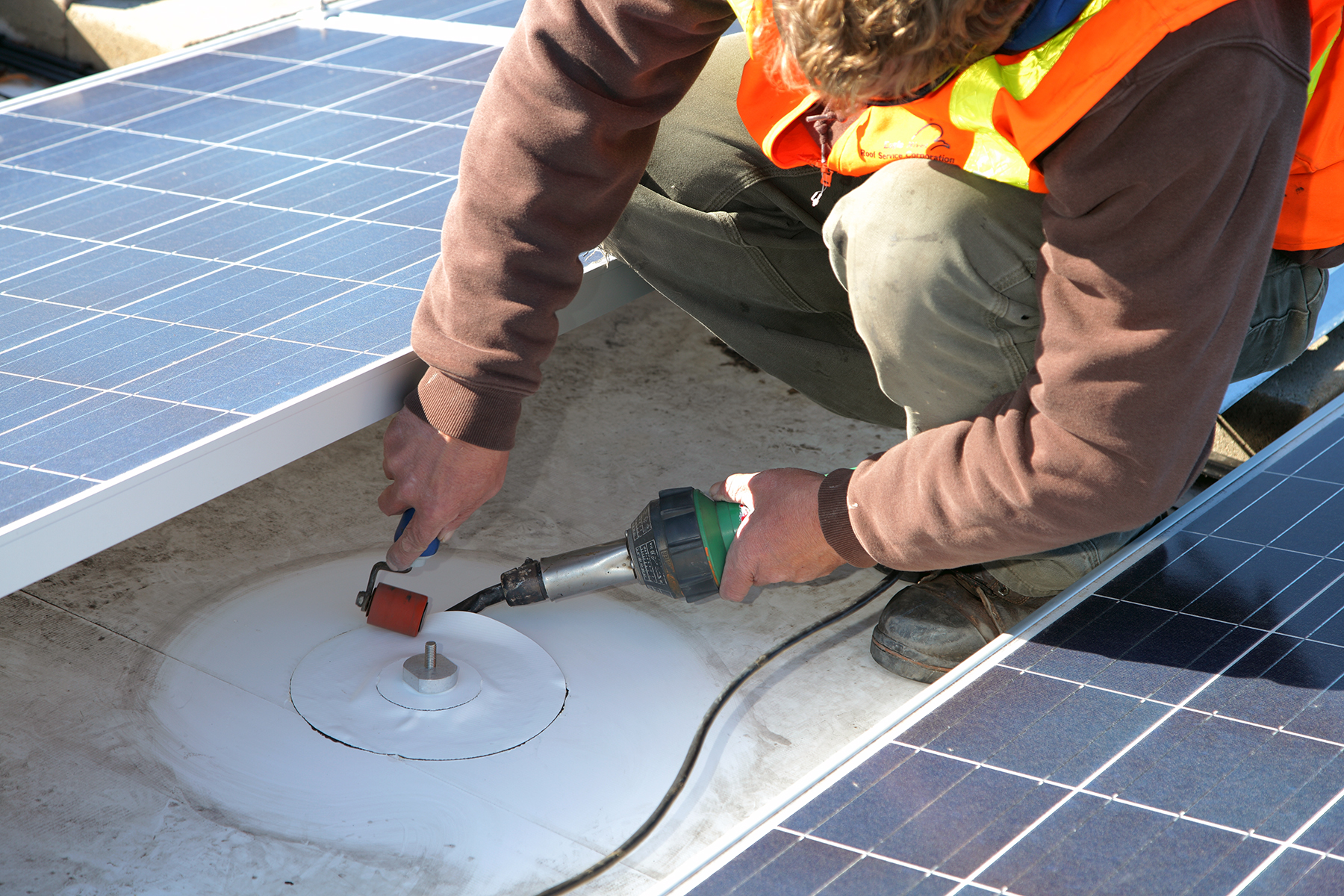
There are two ways to hold a solar array to a flat roof, and they create very different roofing problems. Ballasted racking sets the array on weighted pads or concrete blocks and never punctures the membrane, which is the cleaner option when the building can carry the weight. Mechanically attached racking anchors each support foot through the membrane and into the deck, and every one of those penetrations is a potential leak unless it is flashed to the manufacturer's detail and tied into the existing system correctly. On a single array you can be looking at dozens of these attachment points. We treat each one like any other roof penetration, because that is what it is.
The other penetrations people forget about are the conduit runs. The wiring from the array down to the building's electrical room has to cross the membrane somewhere, often at several points, and we have seen too many of those runs flashed with a generic pipe boot or, worse, conduit fastened straight to the membrane where it abrades a hole over a couple of winters. Conduit penetrations get proper through-roof details, and we want to be in the room with the solar electrician before they pull a single wire so the routing and the flashing are agreed on in advance.
Weight, uplift, and the structure underneath
Every solar approach adds load, and on Akron's older mid-century commercial buildings the original design loads were often modest. Ballasted systems in particular put real concentrated weight on the deck, and that has to be checked against the building's structural capacity, not assumed. Wind uplift cuts the other way: a low-profile array still catches wind, and on an exposed roof along an open corridor the array's own attachment and the roof's edge securement both have to handle the uplift the panels generate. We coordinate these numbers rather than guessing at them, and where a structural engineer needs to weigh in, we say so.
Warranty coordination is where most projects go sideways
Here is the part that quietly voids more roofs than bad flashing does. Most major single-ply membrane manufacturers will allow a rooftop array on a warranted system, but only if the array design and installation follow their rules: approved ballast pads, approved walkway protection around and through the array for service access, approved penetration details, and a pre-installation review by the manufacturer's warranty rep. Skip that review, and the array can void the membrane warranty on a roof that may have a decade or more of coverage left. We run the manufacturer warranty review as part of any solar-plus-roofing job and keep the documentation so the coverage survives the installation.
We do not sell solar systems and we have no stake in which array you choose. What we do is make sure the roof is the right age, the structure can carry the system, the penetrations are detailed correctly, and the warranty stays intact, so the solar investment pays off instead of becoming the reason you reroof early. If you are weighing a rooftop solar project anywhere in Akron or Summit County, talk to us before the roof becomes an afterthought.
Solar Roof Integration in Akron, OH Questions
Should we reroof before installing solar, or can we put it on the existing roof?
It comes down to remaining service life. With fifteen-plus years of documented life left in the membrane, installing on the existing roof is fine. With seven years or fewer, reroofing first almost always wins on total cost, because removing and resetting an array during a future reroof costs far more than installing solar on a fresh membrane now. We assess the membrane and give you a service-life estimate before you commit either way.
Does mounting the panels mean putting holes in my roof?
Not necessarily. Ballasted racking holds the array down with weighted pads and never penetrates the membrane, which is the common choice on flat Akron roofs that can carry the load. Mechanically attached racking does penetrate, and when it does, every foot is flashed individually to the manufacturer's spec and kept under the membrane warranty. Conduit crossings get proper through-roof details either way.
Will a solar array void my roofing warranty?
It can, if the installation ignores the manufacturer's requirements. Most single-ply manufacturers allow rooftop solar on warranted systems provided the design uses approved ballast pads, walkway protection, and penetration details, and gets a pre-installation review from their warranty rep. We coordinate that review and keep the paperwork so your remaining coverage stays valid.
Which membrane works best under a solar array?
A white reflective TPO or PVC membrane is the usual pick. The reflective surface keeps the deck under the panels cooler, which helps panel output, and a mechanically attached system gives ballasted racking a stable, uniform base. Where structural load limits ballast weight, a fully adhered system can be the better answer.
Do you coordinate with my solar contractor on sequencing?
Yes, and it matters. The membrane goes down and gets inspected before any racking is set, and conduit penetrations are flashed by us, not the solar electrician, before wire is pulled. We hold a pre-construction meeting with the solar crew to lock in the sequence, the conduit routing, the penetration details, and the final inspection both warranties will require.