
Brewery, Distillery & Food Production Roofing for Akron commercial properties
The technical challenge that distinguishes brewery, distillery, and food production facility roofing in Akron from standard commercial work is vapor control. Active fermentation generates CO₂ and steam; brew kettles and heat exchangers produce sustained moisture loads; and the building's humidity management systems are often fighting to maintain a reasonable interior condition year-round. The vapor pressure profile of a production brewery is closer to a natatorium than a warehouse — and an insulation assembly that works for a warehouse will fail within a few seasons in a brewing environment. We design the vapor control layer for the actual conditions, not for a generic commercial occupancy classification.
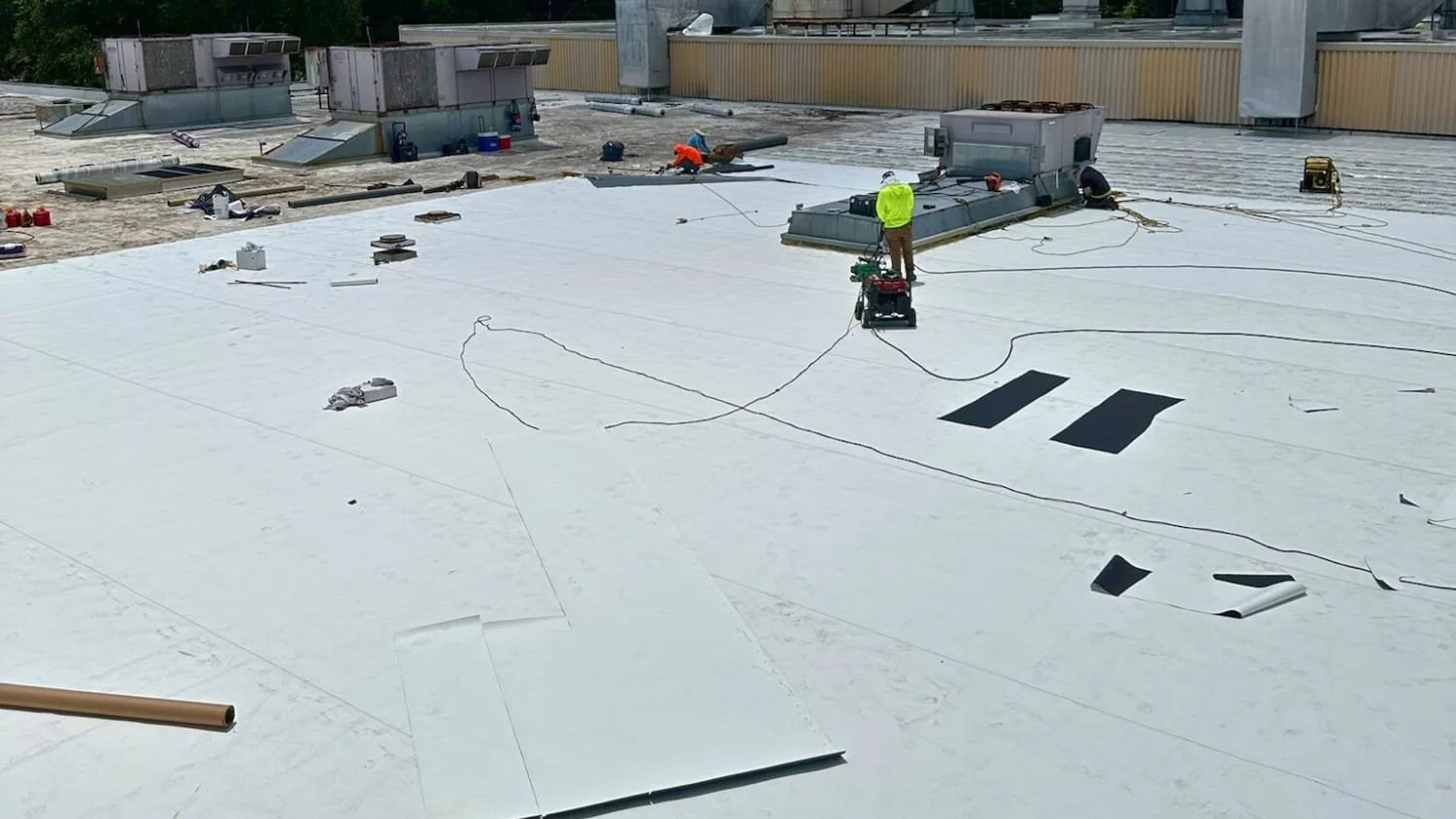
Membrane selection for brewery roofing in Akron is driven by chemical compatibility. Sanitation chemicals used in production facilities — caustic soda, peracetic acid, chlorinated cleaners, sanitizing acids — migrate onto the roof surface through HVAC drainage, process exhaust condensate, and roof drain overflow from cleaning operations. TPO and PVC membranes resist these chemicals significantly better than EPDM. Heat-welded seams perform better than adhesive-bonded seams in chemical-exposure environments because adhesive bond strength degrades faster than welded thermoplastic seam strength under chemical attack. We specify TPO or PVC for brewery and distillery roofs — not because it's our preference, but because the chemistry requires it.
Equipment loads on brewery and distillery roofs in Akron are substantial and frequently underestimated. Grain silos, CO₂ recovery systems, cooling water towers, high-capacity HVAC handling humidity loads, and process exhaust fans all impose point and distributed loads on the roof plane. Before specifying any new insulation assembly — which adds load — we review the structural drawings with the building's engineer of record to confirm the deck can carry the proposed assembly weight plus all existing equipment. We've found overstressed roof sections at more than one production facility.
How we keep Brewery, Distillery & Food Production Roofing practical
Before pricing Brewery, Distillery & Food Production Roofing, we confirm the roof areas involved, where water is moving, how crews can access the roof, and which assumptions could change the budget after closer inspection. That keeps the recommendation tied to the building instead of a broad square-foot number.
For Akron commercial properties, we also separate immediate stabilization from long-term planning. Temporary dry-in, targeted repair, maintenance, coating, recover, and replacement can all be valid, but they should not be blended into one vague scope.
Brewery, Distillery & Food Production Roofing properties need roof work that respects the people and operations below the roof. Entrances, parking, loading, patient areas, tenants, inventory, mechanical systems, and security procedures can all affect the work plan before materials are ordered.
Access is reviewed early because it can change the whole project. Downtown Akron, medical campus buildings, university-area properties, retail centers, warehouses, and industrial facilities each create different rules for staging, lift use, parking, tenant notifications, safety zones, and after-hours work.
Weather is treated as a project constraint, not background information. Snow, freeze-thaw movement, hail, heavy rain, summer storms, and cold-weather close-in affect how much roof can be opened, how materials are stored, and when temporary protection has to be installed before the next work step.
Budget conversations stay more useful when the drivers are named. Wet insulation, deck repair, tapered insulation, drains, scuppers, coping, wall flashing, rooftop equipment, fall protection, material staging, disposal, and occupied-building sequencing can change cost and timing more than the roof label itself.
Field review also has to respect what the roof is connected to. Rooftop units, condensate lines, exhaust fans, grease containment, skylights, tenant penetrations, parapet walls, expansion joints, and older repair patches can all change where water travels and where a permanent repair has to land.
Scheduling is part of the technical scope. A roof plan that ignores loading access, tenant entrances, parking, material deliveries, noise, odor, security, and business hours can look acceptable on paper while creating unnecessary disruption once crews arrive. We keep those constraints visible before the work starts.
The roof record also calls out unknowns, because hidden moisture, concealed deck damage, blocked drains, and undocumented prior repairs can change the correct next step.
The closeout record matters after the work is done. We keep notes, photo locations, access constraints, completed repair areas, and remaining risk items connected to the roof area so owners can use the file for follow-up maintenance, budget planning, tenant communication, procurement review, or the next capital cycle.
Brewery & Distillery Roofing — Technical Questions
Where does the vapor retarder go in a brewery roof assembly?
In Akron's climate zone, a correctly designed brewery roof assembly positions a high-perm vapor retarder below the insulation and a low-permeance membrane above it — creating a one-way vapor drive that allows moisture to dissipate through the membrane rather than accumulating in the insulation. The specific position and permeance value of the vapor retarder is calculated from the interior relative humidity of the production space (which may run 60-80% in an active brewery) and the exterior climate conditions. A generic commercial vapor retarder specification assumes 35-40% interior RH — not brewery conditions.
How do you specify insulation for a high-humidity production environment?
Polyisocyanurate (polyiso) insulation maintains its R-value well in dry conditions but loses performance at elevated moisture content — above 2% moisture by weight, polyiso can lose 25-30% of its rated R-value. For high-humidity production facilities, we recommend closed-cell spray polyurethane foam (SPF) as an alternative for the base layer — it has lower moisture absorption and maintains R-value better in brewery and distillery environments. The insulation specification for a production facility is a different engineering decision than for a warehouse or office building.
What membrane system is correct for chemical exposure on a brewery roof?
60-mil or 80-mil TPO or PVC fully adhered or mechanically attached, with heat-welded seams. The chemical resistance of TPO and PVC to alkalis, acids, and disinfectant compounds is significantly better than EPDM. Heat-welded seams are more resistant to chemical penetration than adhesive-bonded seams because the weld fuses the membrane into a monolithic joint with no adhesive interface to degrade. For roofs with direct chemical splash exposure at drain locations or exhaust terminations, we install stainless steel protection plates around the highest-exposure penetrations.
How do you handle CO₂ exhaust penetrations on a brewery roof?
CO₂ exhaust vents from fermentation vessels require penetration flashings that allow for thermal movement — CO₂ exhaust vents can run significantly warmer than ambient when active — and that keep the membrane face away from direct exhaust contact. We use stainless steel curb extensions with PVDF-coated flanges for brewery exhaust penetrations, with membrane termination at the curb top rather than wrapping over the exhaust pipe. This keeps the membrane face away from the direct exhaust stream and allows the curb to handle the thermal cycling independently of the membrane.
What happens if wet insulation is found during a brewery re-roof?
Wet polyiso insulation in a brewery environment doesn't recover when it dries — at the moisture levels typical in production facilities, insulation that has been wet for more than one season is degraded. We remove all wet insulation discovered during tearoff, document the extent with photographs and core sample records, and replace it as part of the re-roofing scope. If wet insulation extends into areas not originally in scope, we bring the additional area to the owner's attention with photographic documentation and a unit-price change order before proceeding.