
Pharmaceutical & Laboratory Roofing for Akron commercial properties
A leak over a warehouse is an inconvenience. A leak over a cleanroom bench, a stability chamber, or an analytical instrument worth more than the building's annual roof budget is a quarantined batch, a deviation report, and a quality investigation. That difference shapes everything about how we approach pharmaceutical and laboratory roofs in Akron. The membrane has to be sound, but the discipline around the work matters just as much.
Akron's lab and life-science footprint runs deeper than people expect for a city built on rubber. The polymer and materials research tied to the University of Akron, the analytical and formulation labs scattered through the Akron Global Business Accelerator and the Bridgestone Americas Technical Center, the medical and diagnostic labs around the Summa and Cleveland Clinic Akron General campuses, and the contract testing and specialty chemistry shops out along the I-77 and Route 8 corridors all put sensitive, environmentally controlled space directly under a low-slope roof. We treat each of those roofs as part of a controlled environment, not just weather protection.
Zero tolerance over the equipment that matters
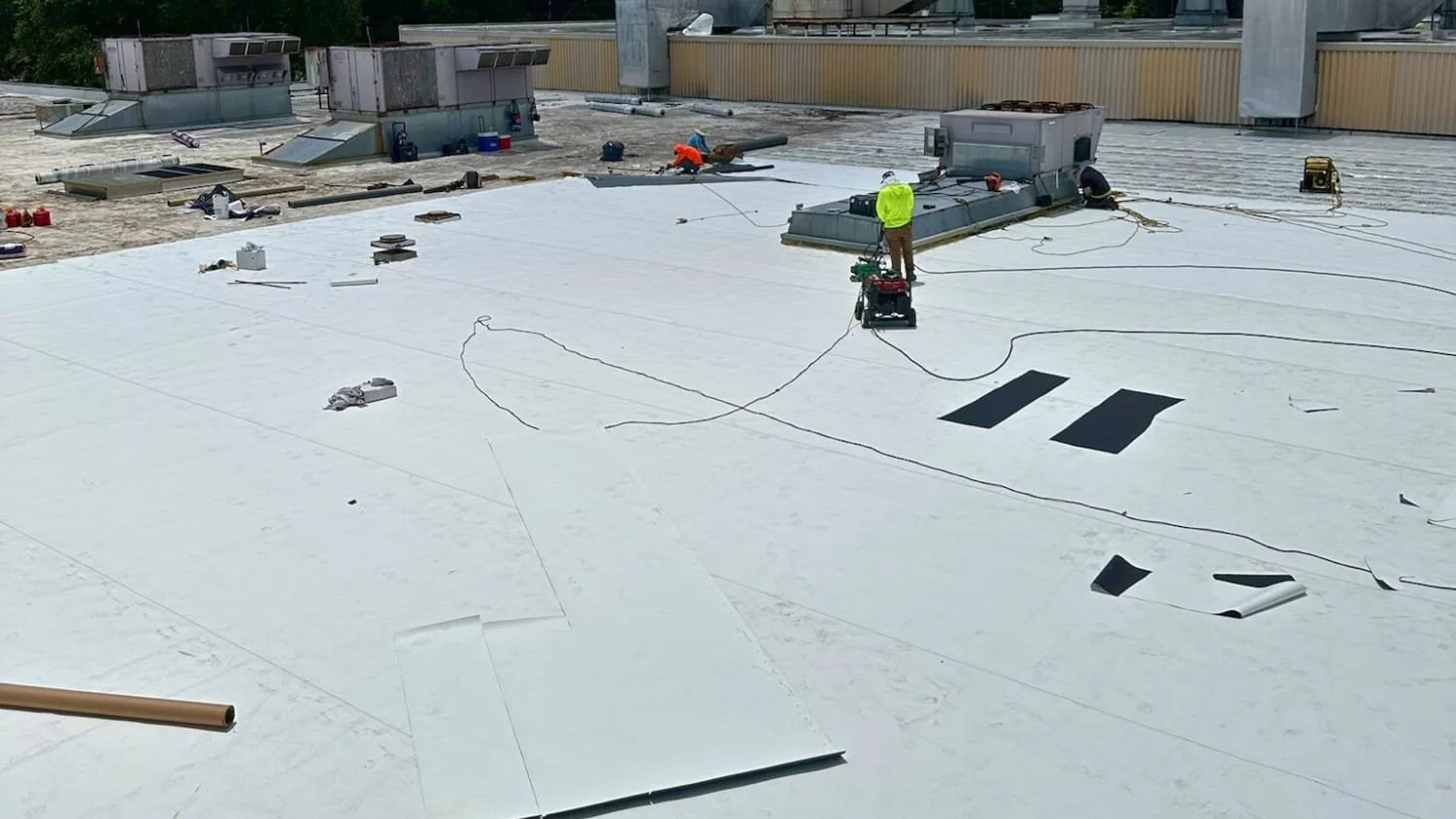
The governing rule on these buildings is simple to state and hard to deliver: no water reaches the space below, ever, including during construction. We design the work so the building envelope over critical labs is never open and exposed. That means tight phasing, complete daily dry-in confirmed before crews leave, and temporary protection staged before a section is opened rather than scrambled for after a cloud rolls in. A controlled space cannot ride out a Northeast Ohio thunderstorm with an open deck.
Cleanroom HVAC curbs and pressure
Lab and pharma roofs carry an unusually dense and unusually sensitive mechanical load. The HVAC serving a cleanroom holds tight pressure cascades and tight particle counts, and the curbs for those units, the supply and return penetrations, and the BMS conduit all pass through the membrane in clusters. We flash each one as its own detail and, just as important, we coordinate any work near a cleanroom air handler with the facility's mechanical team so a pressure cascade is not disturbed while a curb is open. Where a flashing repair touches a unit serving a classified space, we plan it into a scheduled HVAC window and confirm the room recovers its pressure and particle count afterward.
Keeping the deck clean during the work
Cutting and grinding over a building with classified interiors is a contamination question, not just a roofing one. We contain debris, keep tear-off dust out of intakes, and protect open penetrations so nothing migrates down a shaft into a space that is validated to be clean. The roof crew's housekeeping is part of the facility's contamination control while we are on site.
Corrosive exhaust and membrane chemistry
Lab fume hood and process exhaust stacks discharge solvent, acid, and other corrosive vapors right at roof level. In Akron's weather those vapors condense on the stacks and drip onto the membrane downwind, creating localized chemical attack that a standard sheet is not warrantied to survive. Before we specify anything near an exhaust stack, we get the exhaust stream chemistry from the facility's mechanical or EHS group and match the membrane and flashing to it. We favor PVC and KEE-based membranes in those zones for their chemical resistance, and we use stainless or otherwise compatible flashing where the discharge is aggressive. A generic TPO sitting downwind of an acid exhaust will not last.
- Fume hood and process exhaust stacks, with the membrane matched to the actual discharge chemistry
- Cleanroom air handler curbs detailed and coordinated to preserve pressure cascades
- Stability chamber and cold-storage roof zones where condensation control is critical
- BMS, instrument gas, and process piping penetrations clustered and individually flashed
Access, credentialing, and the closeout package
Regulated buildings control who gets on the roof and what paperwork follows the job. Many Akron lab and pharma sites require contractor pre-qualification, background screening, and site-specific safety and contamination training before a crew ever reaches the ladder. We start that credentialing weeks ahead so the full crew is cleared by the mobilization date rather than losing a day at the gate. At closeout we deliver the documentation these facilities expect: material submittals, daily reports, a penetration inventory tied to the roof plan, system certification where required, and warranty registration, organized so a quality or facilities group can drop it straight into their records.
Why standard commercial risk tolerance does not apply
On a typical building, a small problem found mid-project is a change order. On a validated lab or a GMP suite, the same problem can ripple into product, into compliance, and into a remediation bill that dwarfs the roof. We plan these jobs to remove that risk up front rather than manage it after the fact, because the cost of being wrong here is measured in batches and investigations, not square feet.
Pharmaceutical & Laboratory Roofing Questions
How do you guarantee no water gets into a cleanroom during a reroof?
We design the sequence so the envelope over critical space is never left open and exposed. Sections are opened only with temporary protection staged in advance, and we confirm a complete watertight dry-in before crews leave each day. In Akron weather we never let a controlled space sit under an open deck overnight.
What membrane do you use near corrosive lab exhaust?
We get the actual exhaust chemistry from the facility's mechanical or EHS team first, then specify a chemically resistant membrane — usually PVC or KEE-based — in the downwind zone, with compatible flashing such as stainless where the discharge is aggressive. A standard TPO downwind of a solvent or acid stack will not hold up.
How do you protect cleanroom pressure while working on the roof?
Any flashing or curb work near a cleanroom air handler is coordinated with the facility's mechanical team and scheduled into an HVAC window so a pressure cascade is not disturbed while a penetration is open. After the work, we confirm the room recovers its pressure differential and particle count.
Do you handle the access and credentialing these sites require?
Yes, and we start early. We initiate contractor pre-qualification, background screening, and any site-specific safety and contamination training weeks before mobilization so the whole crew is cleared by the start date instead of losing a day at the gate.
What closeout documentation do you provide?
Material submittals, daily work reports, a penetration inventory keyed to the roof plan, system or FM/UL certification where required, and warranty registration — organized so a quality or facilities group can file it directly into their records.