

Industrial Flex Space Roofing for Akron commercial properties
The flex roof that changes every time a lease turns over
A flex building rarely looks the same two years running. The bay that held a machine shop becomes a logistics 3PL; the unit that was a contractor's warehouse turns into a small-batch maker space; a single-tenant span gets demised into three. Every one of those moves leaves a mark on the roof. We've walked enough flex roofs along Akron's Gilchrist Road and Massillon Road clusters, the East End redevelopment near the old B.F. Goodrich complex, and the industrial pockets feeding I-76 and I-77 to know that the membrane is the easy part — the history written into it is what we actually have to manage.
Akron earned its industrial bones as the Rubber Capital, and the flex inventory here reflects that. A lot of these buildings are 1970s and 1980s tilt-wall or block construction that started life as straight warehouse and got carved up for mixed light-industrial use over the decades. The roofs carry the receipts: abandoned curb stubs, rooftop conduit that no longer powers anything, and patch jobs from three different tenants who each called a different contractor.
We survey penetrations before we price anything
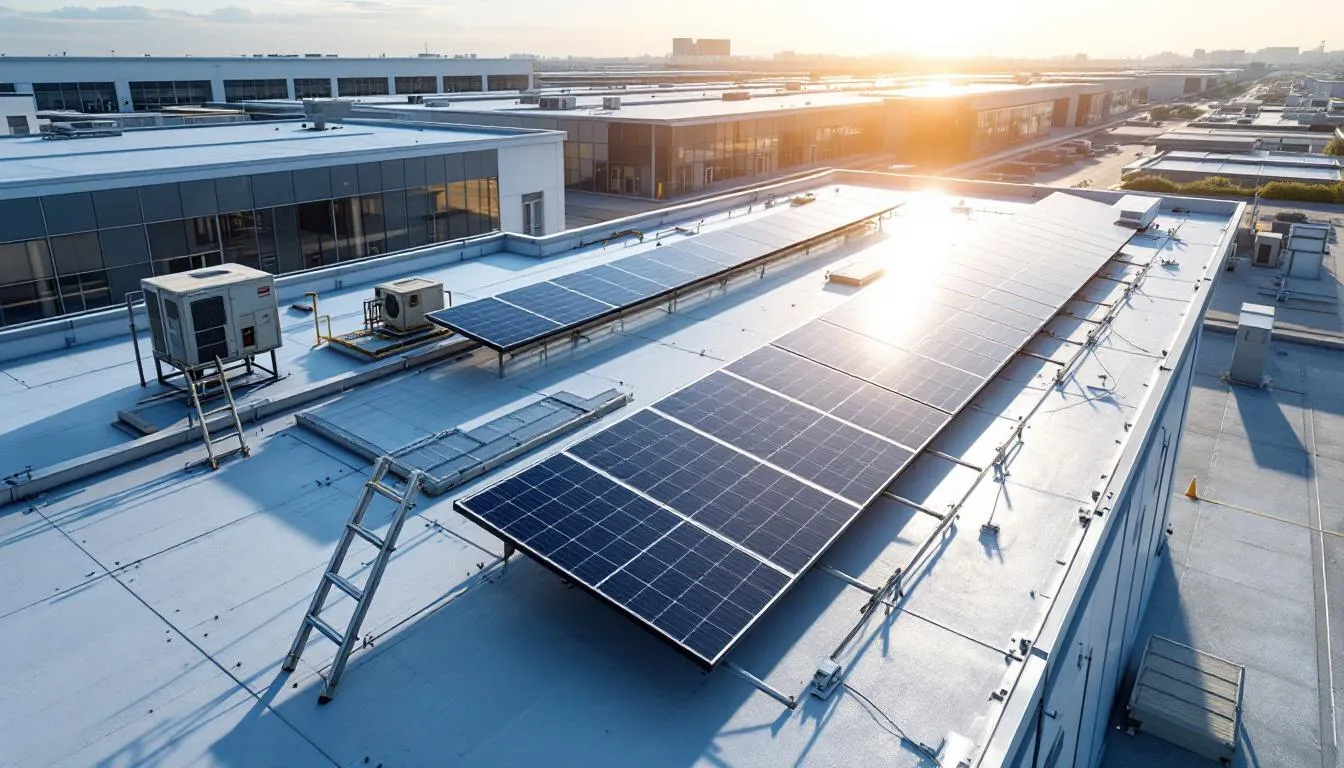
Multi-tenant flex roofs accumulate openings the way a desk accumulates paper. Each tenant build-out tends to add a rooftop unit, a few new conduit runs, an exhaust fan, maybe a make-up air unit — and the property records almost never keep up. Before we put a number on a reroof, we photograph and map every penetration on the deck, flag the ones that are dead, and identify the ones that were never flashed to spec in the first place. Skipping that step is how a roofer ends up owning a leak that predates their warranty.
Vacant bays are their own hazard. When a tenant pulls out and yanks their rooftop equipment, the curb opening usually gets a temporary cap that holds for about two storms. We see those failures most in the shoulder seasons, when a unit sits empty through Akron's freeze-thaw swings and nobody is inside to notice the ceiling staining until a new tenant tours the space.
Membrane choices for tilt-wall and pre-engineered flex
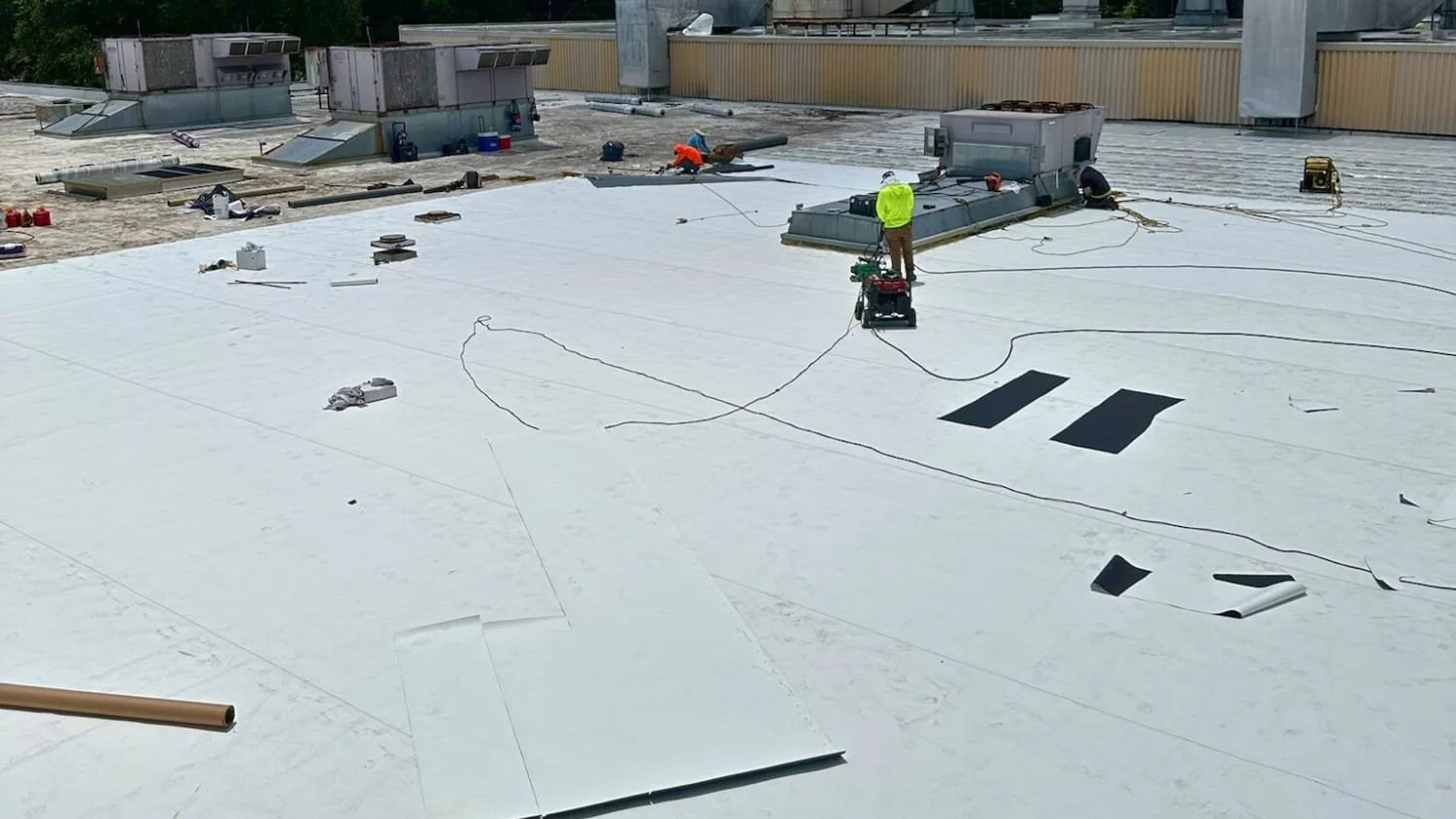
For concrete and tilt-wall flex, our default is a 60-mil TPO mechanically attached over new polyiso, with tapered insulation where the original deck never drained right. On buildings with heavy rooftop traffic from multiple tenants' HVAC contractors, we'll step up to 80-mil TPO or a fully adhered 60-mil PVC for the puncture and grease resistance. Pre-engineered metal flex buildings — common in the newer parks off Arlington Road and out toward Green — are a different animal: we evaluate a standing-seam recover or a silicone coating against a full tear-off based on panel condition, purlin spacing, and what the deck can actually carry.
Coordinating around tenants who don't share a schedule
The thing that makes flex roofing hard isn't the roofing — it's that ten tenants run ten different operations under one membrane. We start every multi-tenant project with a bay map and a contact list from property management: who has live rooftop equipment, which bays sit empty, who runs second shift, who can't tolerate an HVAC shutdown during business hours. Tenants get advance notice through the property manager, not direct calls from the crew, and every section is dried in before we leave for the day.
What an investor or property manager gets from us
- A penetration inventory and roof-zone diagram that documents the deck as it actually exists, not as the original drawings show it
- Fixed-price proposals after a physical roof walk, with core cuts where the assembly history is unclear
- Standardized condition reports across a portfolio, so capital planning lines up building to building
- Curb-cap and drain checks built into every lease-transition inspection, before a new tenant signs
- Coordination with tenant build-outs so new rooftop equipment lands on properly flashed curbs the first time
Drainage, snow load, and the Akron freeze-thaw cycle
Flat flex roofs in Northeast Ohio live and die by drainage. Akron sits in a snow belt that catches lake-effect bands off Lake Erie, and a roof that ponds in October becomes a roof carrying frozen ballast in January. We pay close attention to internal drains and scuppers on these buildings because tenant build-outs have a habit of stacking new equipment right where the water needs to go, and a single blocked or buried drain can hold hundreds of pounds of standing water over a structure that was never sized for it. Where the original deck never drained well, tapered insulation rebuilt into the reroof is usually cheaper over the roof's life than chasing ponding repairs every spring.
The freeze-thaw swing also drives a maintenance rhythm we recommend to every flex owner: a fall walk before the snow flies to clear drains and confirm flashings are tight, and a spring walk to catch the splits and fastener backout that a hard winter opens up. On a multi-tenant building those two visits a year are what keep a small detail from turning into a tenant's leak — and a tenant's leak into a lease dispute.
Common questions on flex space roofing in Akron
How do you handle undocumented tenant penetrations?
We map and photograph every opening on the deck before work starts and compare it against original drawings when they exist. Dead penetrations get cut out and infilled; improperly flashed ones get corrected before new membrane goes down. That record becomes part of your closeout file so there's no warranty dispute later about a leak that was already there.
Which membrane is right for a multi-tenant building?
Sixty-mil TPO mechanically attached over tapered polyiso covers most tilt-wall and block flex buildings here cost-effectively. If the roof carries heavy service traffic or sits under a lot of grease-laden exhaust, 80-mil TPO or adhered PVC earns its higher cost in durability.
Can you work around tenants with different lease terms and shifts?
Yes. We sequence the work off a bay-by-bay occupancy map, identify which tenants have noise or HVAC-downtime sensitivity, and run all notice through property management. Daily dry-in keeps every occupied bay protected regardless of where the active work zone is that day.
Do you handle standing-seam metal on pre-engineered buildings?
We do. Metal flex roofs get evaluated for a coated-metal or retrofit standing-seam recover versus full replacement based on panel condition, fastener pull-out, and load capacity. We install both approaches across the Akron market.