

Drone Roof Inspection in Akron, OH for Akron commercial properties
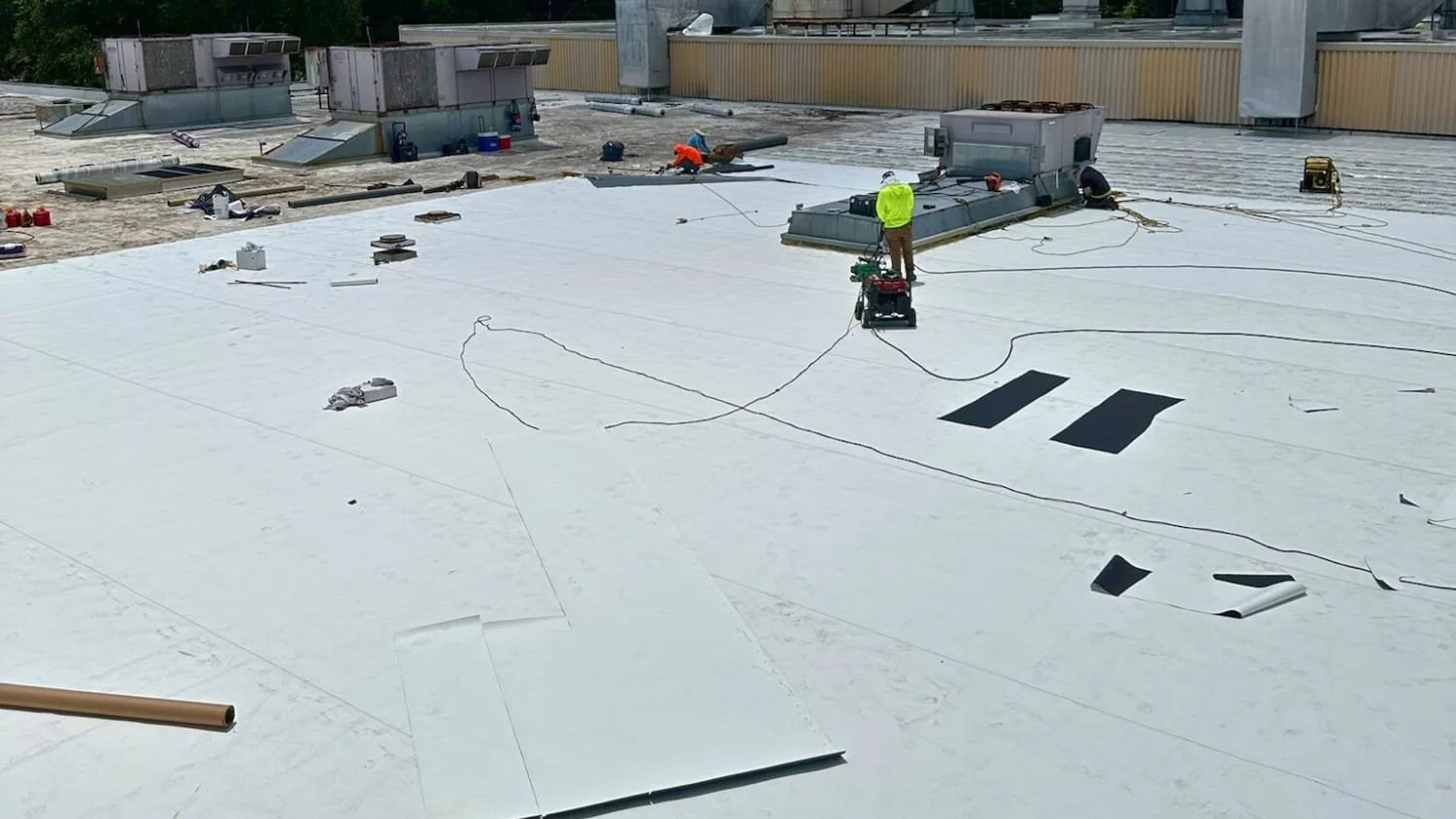
The most expensive problem on a flat commercial roof is the one you cannot see from standing height. Moisture works its way past a failed seam or a tired flashing, soaks into the insulation, and spreads sideways under a membrane that still looks fine from the parapet. By the time it shows up as a ceiling stain inside, it has often saturated hundreds of square feet of board. A drone carrying a thermal camera finds that wet insulation while it is still contained, which is the whole reason we fly roofs instead of just walking them.
What thermal imaging actually shows
Wet insulation holds heat differently than the dry board around it. After a sunny day, the roof warms up, and as it cools off after sunset the saturated areas give up their heat more slowly and glow against the cooler dry field in infrared. That cool-down window is when we fly for moisture, and a clean thermal pass maps the exact footprint of the wet material, even when the membrane surface above it shows nothing at all. That single image is what separates a targeted repair from a full tear-off. If only a few hundred square feet are wet, you cut and replace that insulation and recover. If the moisture has run the length of the deck, you are looking at replacement, and it is far better to know that from a thermal map than from a core sample taken in the wrong spot. Either way, the guesswork comes out of the specification.
Why Akron's building stock makes this worth doing
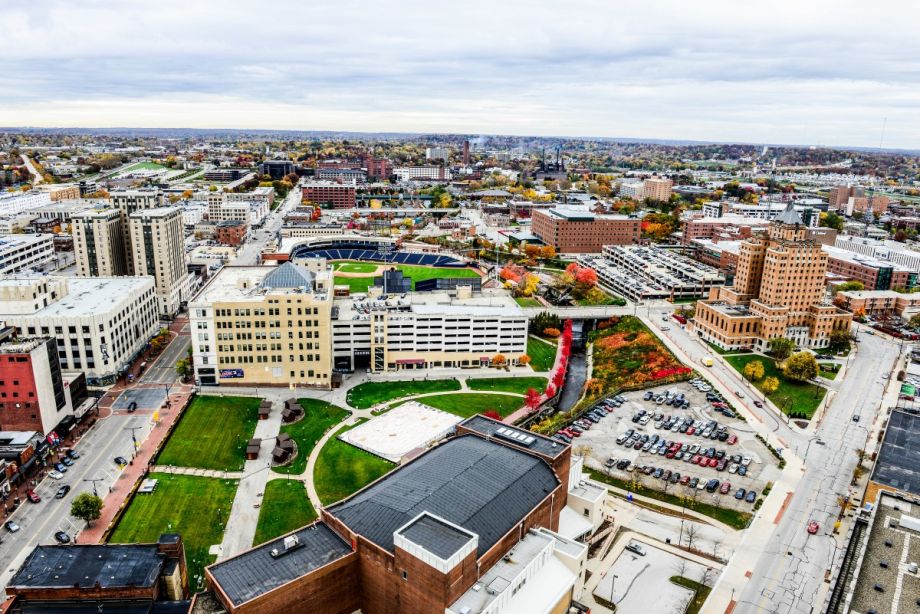
The roofs where aerial inspection pays off are the big low-slope decks, and Akron has plenty of them. The distribution and light-industrial buildings strung along the I-77 and Route 8 corridors, the retail centers around Chapel Hill and Montrose, the older converted plants near Firestone Park, the institutional roofs around the University of Akron and the downtown medical campuses — these are roofs measured in tens of thousands of square feet, where a manual walkover takes hours, misses the low spots where water ponds, and cannot produce a thermal map at all. Flying one of these roofs gives us complete, consistent coverage in a fraction of the time and without sending a crew across a membrane whose condition we have not yet confirmed.
Documentation that holds up for an insurance claim
After a hail event or a wind storm, the difference between a paid claim and a denied one is usually documentation. We produce GPS-tagged imagery that pins hail impact locations and density, shows wind-displaced membrane and lifted edge metal, and records damage to rooftop equipment and curbs, all keyed to position on the roof so an adjuster can review it remotely. We format the report to match what commercial property carriers expect to see, and for time-sensitive storm claims we can turn the documentation package around quickly so it lands while the event is still fresh. We document what the roof shows as a contractor; we do not act as a public adjuster or promise an outcome on your claim.
Flying legally and safely
Commercial drone work is regulated, and we treat it that way. Flights are conducted under the FAA's Part 107 rules with a certified remote pilot, and where a roof sits inside controlled airspace near the Akron-Canton or Akron Fulton airfields, we secure the required authorization before we launch. Keeping a crew off an unknown-condition roof is itself a safety decision: a membrane that is already failing does not need foot traffic added to it, and the people who would otherwise be walking it stay on the ground.
Cleaner specifications before you reroof
Aerial inspection is not only a diagnostic tool, it is a measurement tool. Before we or anyone else writes a reroofing proposal, a flight confirms the actual roof area, locates every penetration, curb, and drain, and records existing conditions against the drawings. Specifications set on what the roof actually is, rather than on assumptions from a quick walkover, cut down on the requests for information and change orders that drive up cost once a crew is mobilized. The flight pays for itself in a tighter, more defensible scope.
Drone Roof Inspection in Akron, OH Questions
How is a drone inspection different from someone walking my roof?
A flight covers the entire surface systematically from a consistent height, producing a complete photographic record without the foot traffic that wears on a membrane and adds risk on a roof that is already failing. It is most valuable on large low-slope roofs where a walkover takes hours and misses the ponding areas you cannot see from standing. And thermal moisture mapping simply is not practical on foot across a big roof — it needs the even coverage only a flight gives.
Can thermal imaging really pinpoint where moisture is trapped?
Yes, under the right conditions. We fly during the cool-down after sunset, when wet insulation holds heat longer than the dry board around it and shows a clear thermal signature in infrared. The resulting map is accurate enough to drive the call between partial replacement and full recovery — which can be the difference between a repair scope and a complete tear-off.
How do you use the footage for an insurance claim?
We deliver a GPS-tagged report documenting hail impact locations and density, wind damage patterns, equipment and flashing damage, and overall membrane condition, formatted to match what commercial property carriers expect. It is ready to submit straight to the adjuster. We document conditions as a contractor and do not act as a public adjuster or guarantee a claim result.
What kind of roofs are the best fit for a drone inspection?
Large flat commercial roofs — distribution and industrial buildings, retail centers, office complexes, multi-building campuses. It is less essential on small or steeply sloped roofs where a manual check is quick and complete. For any commercial roof over about 10,000 square feet that needs a full condition assessment, flying it is the more thorough and efficient route.
Are these flights done legally?
Yes. We fly under FAA Part 107 with a certified remote pilot, and for roofs inside the controlled airspace around the Akron-Canton or Akron Fulton airfields we obtain the required airspace authorization before the flight. Safety on the ground and in the air is part of the standard, not an afterthought.