

Data Center Roofing for Akron commercial properties
Akron's data center market has expanded steadily as Northeast Ohio positions itself as a secondary colocation hub for companies seeking cost relief from oversubscribed Cleveland and Pittsburgh markets. The city's fiber infrastructure, powered by long-haul routes running along the I-76 and I-77 corridors, has attracted edge deployments and enterprise private data centers in the Summit County business park belt. Suburban campuses along the Portage Lakes corridor and out toward Copley Township have seen shell buildings converted into temperature-controlled server environments, many with limited original roof specifications that were never designed for data center loads.
Data Center Roofing in Akron operates under a different risk calculus than standard commercial work. When a roof fails on a distribution warehouse, you lose inventory. When a roof fails over a data center, you may lose millions of dollars per hour in downtime, contractual SLA penalties, and permanent client relationships. Every penetration, every seam, and every flashing detail carries that weight. Facilities managers here have learned this lesson expensively enough that multi-layered redundancy in waterproofing — not just a single membrane — has become the standard expectation on mission-critical builds.
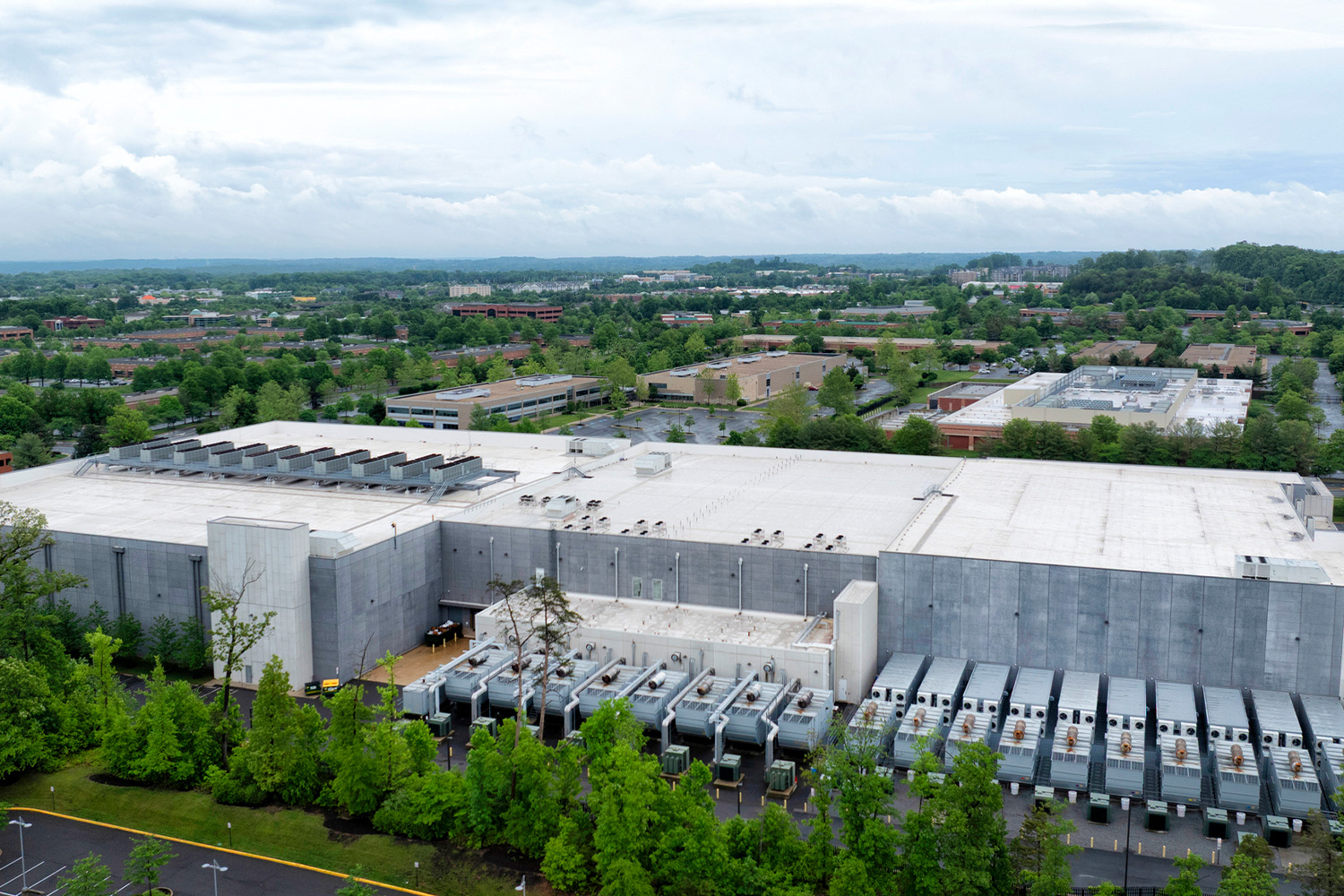
CRAC and CRAH unit placement on Akron data center roofs presents one of the most demanding penetration scenarios in commercial roofing. Modern facilities running hot-aisle/cold-aisle containment push significant cooling loads to rooftop equipment. Each unit requires a curbed opening, vibration-isolated curb assembly, and positive drainage routing to prevent water from pooling near any mechanical penetration. In older Portage Lakes-area conversions, the existing roof slope is often insufficient, requiring tapered insulation systems to redirect drainage away from the densest penetration fields.
Generator systems present a related challenge. Akron data centers typically deploy N+1 or 2N diesel generator configurations for Tier III or Tier IV uptime assurance. Each generator requires exhaust flashing penetrations sized for high-temperature stack discharge, fuel line conduit entry points, and in many cases raised equipment pads that transfer seismic and vibration loads into the roof deck. EPDM and TPO membranes both perform well here when properly detailed with pitch pockets and two-piece flanged collars, but the installation sequence matters: generator commissioning vibration tests should happen before final membrane termination wherever the schedule allows.
Northeast Ohio weather imposes meaningful roofing challenges specific to data center construction. Akron averages roughly 40 inches of annual precipitation and sits in the Lake Erie snow belt, receiving lake-effect accumulation that can reach 60 or more inches in heavy winters. Data center roofs in this market typically carry heavier design loads than the region's general commercial baseline, and drainage system sizing must account for the rapid melt cycles that come when temperatures swing between the low teens and the mid-40s in a single weather system. Ice damming at parapets adjacent to HVAC exhaust areas is a recurring failure point that proper thermal design — adequate insulation R-value and air barrier continuity — can prevent.
The conduit and cable tray penetration density on a mature Akron data center roof often surprises roofers accustomed to office or retail work. A medium-density colocation facility can have 50 to 100 roof penetrations from power conduit alone, plus fiber raceways, grounding cable exits, and low-voltage control wiring for rooftop sensors. Every one of those penetrations is a potential water entry point and must be treated as such: pitch pockets maintained and topped regularly, lead or EPDM pipe boots sized correctly for the conduit OD, and all conduit entries sleeved and caulked against wind-driven rain infiltration.
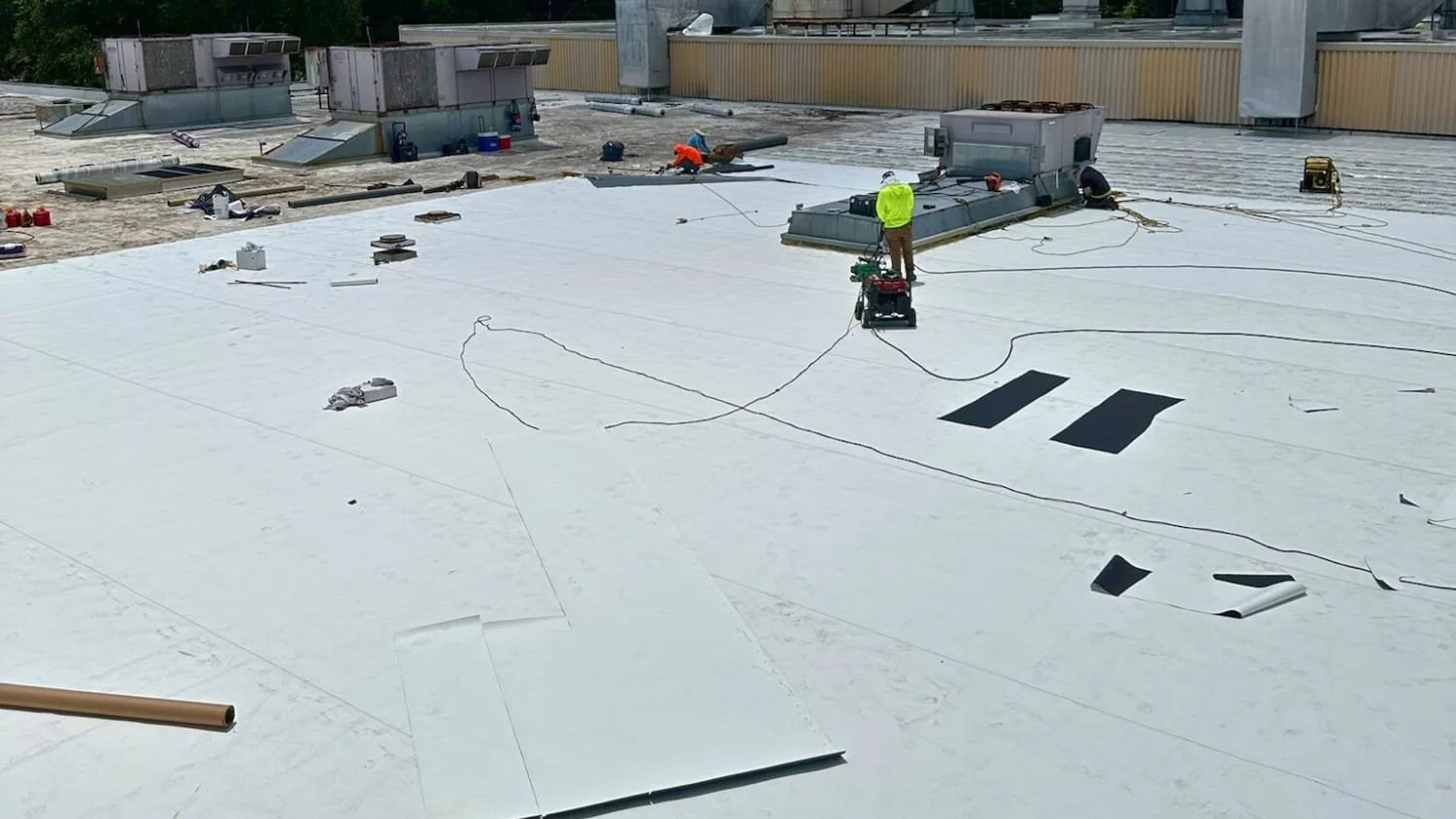
TPO membranes in 60 or 80 mil thickness have become the dominant choice for new Akron data center builds because of their UV resistance, heat-weld seaming that eliminates adhesive failure modes, and compatibility with the white reflective surface that helps reduce cooling loads in a facility running 24/7 mechanical cooling. EPDM remains common on retrofit projects where the existing roof substrate is compatible with adhesive-set systems and the project timeline doesn't accommodate full tear-off. PVC membranes are occasionally specified where chemical resistance is required near emergency generator fuel storage proximity, since certain petroleum distillates can degrade TPO at points of prolonged contact.
Raised floor loading in Akron conversion projects creates a secondary roofing consideration that is easy to overlook: when a building is retrofitted with a raised access floor at server room level, the structural redistribution sometimes shifts point loads to areas that affect roof deck deflection. A deck that deflects more than design tolerances allows ponding water to accumulate near previously adequate drains. Before any Data Center Roofing project in an existing building here, surveying existing drain locations against the actual as-built floor loading plan is a step that pays for itself in avoided callbacks.
Emergency response protocols for roofing work on active Akron data centers require pre-approved maintenance windows, coordinated with the facility's change management process. Night-window installations during low-traffic hours are common, and contractors working on live facilities must follow strict material storage protocols — no organic solvents stored on roof decks overnight, no equipment that could roll into rooftop cooling equipment, and communication plans with the NOC for any work that might affect airflow to HVAC units. The companies that have built long relationships with data center operators in Summit County are the ones that treat these protocols as non-negotiable.
Questions Owners Ask
How do we plan roofing work without scheduling downtime?
Most Akron data center operators use a change management window system — typically overnight between 12 AM and 6 AM on weeknights. We schedule penetration work and any activity near active mechanical equipment within those windows. For full membrane replacement projects, we work in sections, maintaining weathertight continuity over all active mechanical areas while completing adjacent sections in sequence. Pre-job coordination with your NOC team and facilities director sets expectations and prevents surprises.
What membrane type is best for a roof with 80+ penetrations from conduit and HVAC?
For high-penetration roofs, mechanically attached or fully adhered TPO in 60 or 80 mil is generally preferred because heat-welded seams at each pipe boot and flashing tie-in create a monolithic bond that adhesive systems can't match. Every penetration gets a pre-fabricated EPDM or TPO boot sized to the pipe OD, with a welded apron bonded to the field membrane. For irregular conduit clusters, pitch pockets filled with two-part pourable sealer are the backup solution.
How do we protect the roof during generator load testing?
Generator load bank testing in Akron typically runs quarterly or semi-annually. Before testing, confirm all exhaust stack flashings are properly clearanced for high-temp discharge — stack temperatures can exceed 1,000°F at the tip. Any TPO or EPDM within 18 inches of an exhaust stack without a metal heat shield is a burn risk. We install stainless reflective shields on stacks before testing if they're not already in place, and we inspect all adjacent membrane for discoloration or hardening after each test cycle.
Our existing roof has standing water near the CRAC units — what's the cause?
Ponding near CRAC curbs in Akron buildings is almost always caused by one of two things: inadequate positive slope toward drains (less than 1/4 inch per foot), or tapered insulation that was laid out without accounting for the dead load deflection of the roof deck under CRAC curb loading. We survey drain elevations with a digital level, identify low spots, and typically resolve this with a crickets-and-saddles tapered insulation add layer that redirects water without requiring a full tear-off.
What's the typical warranty structure for a Data Center Roofing project?
Standard manufacturer no-dollar-limit warranties on TPO or EPDM systems run 15 to 20 years and cover material and labor. For data center projects in Akron, many operators request an enhanced warranty that includes a response-time SLA — typically 24-hour emergency response for active leaks and a 72-hour repair completion commitment. Not all manufacturers include this in base warranty terms, so it's worth confirming with your roofing contractor which warranty tier includes the response time guarantee before signing off on the specification.